

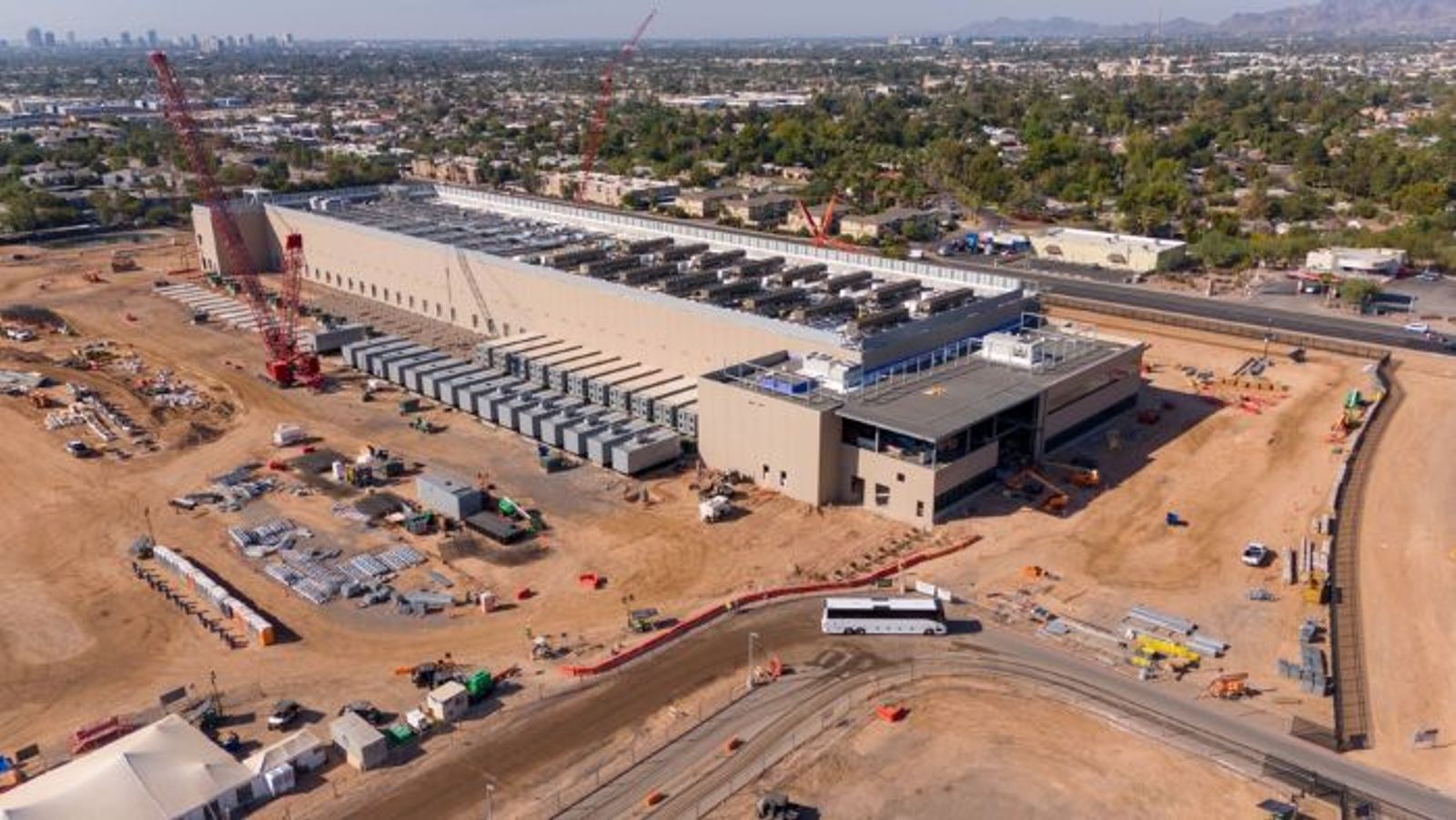
The huge growth in data center development for AI, particularly in the US, is a rapidly expanding value-added business sector for global forwarders and is expected to generate significant air freight volume over the next few years.
While the AI equipment demand competes with e-commerce for air freight capacity out of Asia, handling the fast-growing tech shipments offers better yields and more valuable opportunities for forwarders to add logistics services.
“Data center logistics is something that is in full swing with significant building taking place, especially in the United States,” said DHL CEO Tobias Meyer.
“We have increased our business in two areas, mainly in international transportation along that value chain and inbound to the data center construction side, but also upstream for the staging of material and sequencing at or near the construction sites of those facilities,” Meyer told analysts on a second-quarter earnings call this week.
A report by Synergy Research Group last week shows that the total capacity of US data centers will double in the next three years as booming demand drives the aggressive buildout of data centers owned by hyperscale operators.
“Over the next five years, the US will continue to account for well over half of the world’s operational data center capacity,” John Dinsdale, a chief analyst at Synergy Research Group, said in the report.
Market estimates vary, but there appear to be about 5,000 data centers currently in the US, with another 700 under development.
Global data center infrastructure revenues are forecast to hit $576 billion in 2026, up 70.9% year over year, according to S&P Global, parent company of the Journal of Commerce. That’s being driven by capital expenditures from hyperscalers set to hit $950 billion in 2027 and $1.15 trillion in 2028, said S&P Global, adding that the strength in data centers is offsetting weakness in consumer electronics.
Meyer said there was “a high urgency” to bring these sites into operation, and that urgency was translating into goods that needed interim storage to alleviate bottlenecks at the construction sites. DHL was even taking over installation services at some destinations.
AI-related components have more than 10 times the commercial value density of e-commerce shipments and generate better air freight yields. But the real value for forwarders lies in management contracts covering the wider supply chain.
“We expect significant spare parts business to follow as those installations mature, and that is an area where we are traditionally very strong with our service logistics business,” Meyer said.
“If you think about the telecommunication networks, if you think about the data networks and the general data centers ... we have a pretty strong position in supplying those not only at the pace of the initial build, but also at continuing operations,” he added.
Expanding beyond air freight services
The ongoing demand for AI equipment and infrastructure, and the value-added opportunities it provides, was also highlighted by Kuehne + Nagel CEO Stefan Paul. He told analysts on a second-quarter earnings call July 23 that services related to data center demand were being expanded across the broader supply chain, not just the inbound air legs.
“We started one and a half years ago with air freight first with the inbound legs to the US, then followed with the last mile, the installation activities, [and] leveraging our road business unit as well sea freight,” Paul said.
Kuehne + Nagel has begun rolling out about 300,000 square meters of new warehouse space that will be dedicated to cloud and tech providers linked to US data center corridors.
“We expect that looking at the pipeline in the US and other markets for this tech hyperscaler marketplace, the stickiness of our contract logistics organization and the capability now, including vendor management, has been proven and I have no doubt that we will see more contracts coming in our way,” Paul said.
While global forwarders are all trying to capture the data center business in different ways, there is consensus that the logistics industry is only at the beginning of the demand curve.
Brian Bourke, CCO of SEKO Logistics, said demand for high tech components was surging past that of e-commerce, with “data centers popping up everywhere” and requiring complex logistics services.
“Every fully populated server rack typically has 10 pallets of air freight that go into it due to the packaging of the components,” Bourke told the Journal of Commerce.
The scale of data center development in the US and Europe means the AI-generated business will be around for some time, said Daniel Wall, president and CEO of Expeditors International.
“The ongoing heavy demand from AI hyperscalers shows no sign of slowing down, and we have seen increased demand for freighter space as some hyperscalers are requiring upper-deck access for their servers,” Wall told analysts during a second-quarter earnings call this week.
Expeditors’ second-quarter air freight volume was up 14% year over year, and 16% higher compared with the preceding quarter, driven by demand for data center equipment, but also e-commerce.
“Given the current geopolitical state of the world and rising fuel costs along with tight capacity and routing challenges, air carriers are under enormous strain and may continue to be for some time,” Wall said.
Airlines lifted by higher yields
While forwarders cash in on the value-added services, airlines are reaping the rewards of higher yields. AI-related shipments continue to underpin trans-Pacific growth, with spot rates from Northeast Asia and Southeast Asia to North America both 33% above late-February levels, according to rate benchmarking platform Xeneta.
The second-quarter cargo revenues of several Asian carriers hit multi-year highs as demand for components such as AI servers, graphics processing units (GPUs) and memory chips replaced low-value e-commerce parcels as the primary growth engine.
Airlines near the tech manufacturing centers in South Korea and Taiwan are seeing the greatest impact on their top lines, with Korean Air reporting a 46% year-over-year increase in second-quarter cargo revenue of $1.07 billion, driven by multi-year tech infrastructure commitments.
China Airlines’ second-quarter cargo revenue was up 43.6% at $747.22 million as the Taiwan-based carrier packed its planes with high-tech trans-Pacific shipments, while compatriot EVA Air saw a 44% rise in second-quarter cargo revenue to $602.87 million. AI server-related goods accounted for about half of its Taiwan-US cargo volume.
Cathay Pacific Cargo reported revenue from freight operations was up 24% year over year in the first half at $1.8 billion, with average yields up 18%. The airline carried 868,931 tons of cargo in the first half, up 9% year over year.
Lavinia Lau, chief customer and commercial officer at Cathay Pacific, said there was solid growth in the volume of semiconductors and other tech infrastructure to support the AI boom, particularly on the Asia-to-North America trade lane.
“We see regionally there is a lot of semiconductor trade flows between China, Southeast and Northeast Asia, and semiconductor shipments from Asia to the US have risen strongly,” Lau told reporters during a first-half results briefing this week.
“It is driving air cargo flows both on the trans-Pacific and within Asia,” she added. “That has brought us a lot of opportunities, and we have the network to cover the newfound demand.”
Still, there are some headwinds in the market.
“Nearly 300 US bans or moratoriums on new data centers and rising public opposition across South Korea, Japan and the ASEAN [Association of Southeast Asian Nations] region are pushing growth toward more geographically diversified markets, with Middle East and Africa capacity expected to expand by 38% in 2027 alone,” said S&P Global.