


A burst of imports linked to data center construction in the US is positioning the eastbound trans-Pacific trade for a steady stream of cargo this peak season, forwarder and carrier sources say. Most of the hardware imports needed for data centers are sourced from China.
Still, while imports related to the big data center buildout in the US are keeping volumes elevated, they is masking weakness in the consumer merchandise sector, sources say.
Imports of traditional fall and holiday consumer products are peaking this month because retailers frontloaded shipments in anticipation of US tariff changes effective July 24. The National Retail Federation last week forecast that imports in July will set a new monthly record, but the group expects year-over-year declines of about 3% to 5% each month from August through November.
Steadily increasing imports of hardware, racks and other equipment used in the AI data center buildout will make up for some, although not all, of the drop in consumer merchandise imports this fall, industry sources say.
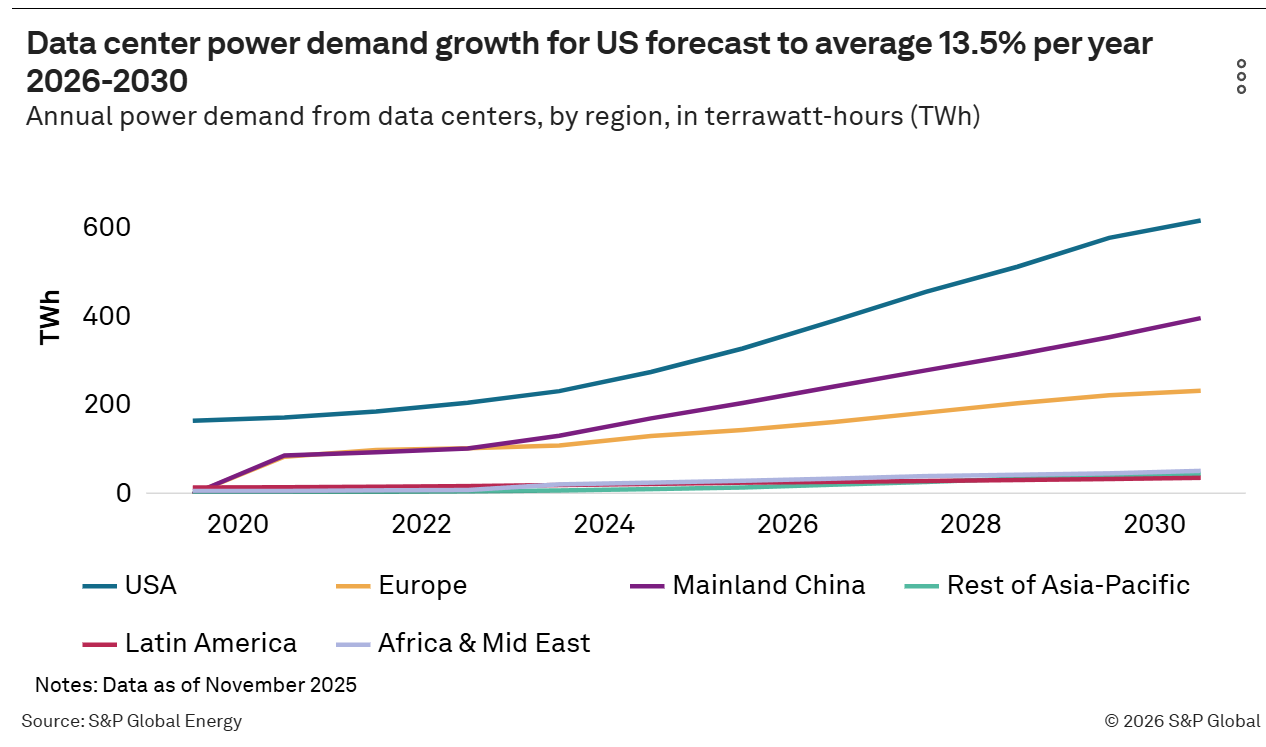
According to S&P Global, data center grid-based power demand is projected to rise by 108% from 337 gigawatt-hours this year to 701 GWh by 2030. S&P Global is the parent company of the Journal of Commerce.
That forecast is backed up by data showing a significant jump in data center-linked imports into the US over the past three years. Cargo consisting of materials and equipment for physical infrastructure, power infrastructure, cooling infrastructure, networking, and IT jumped from 526,425 TEUs in the first six months of 2023 to 817,317 TEUs in the comparable period this year, up 55%, according to PIERS, a sister product of the Journal of Commerce.
That came as US spending on data centers jumped 26.4% year over year in the first quarter, hitting a record $59.3 billion, according to the US Census Bureau.
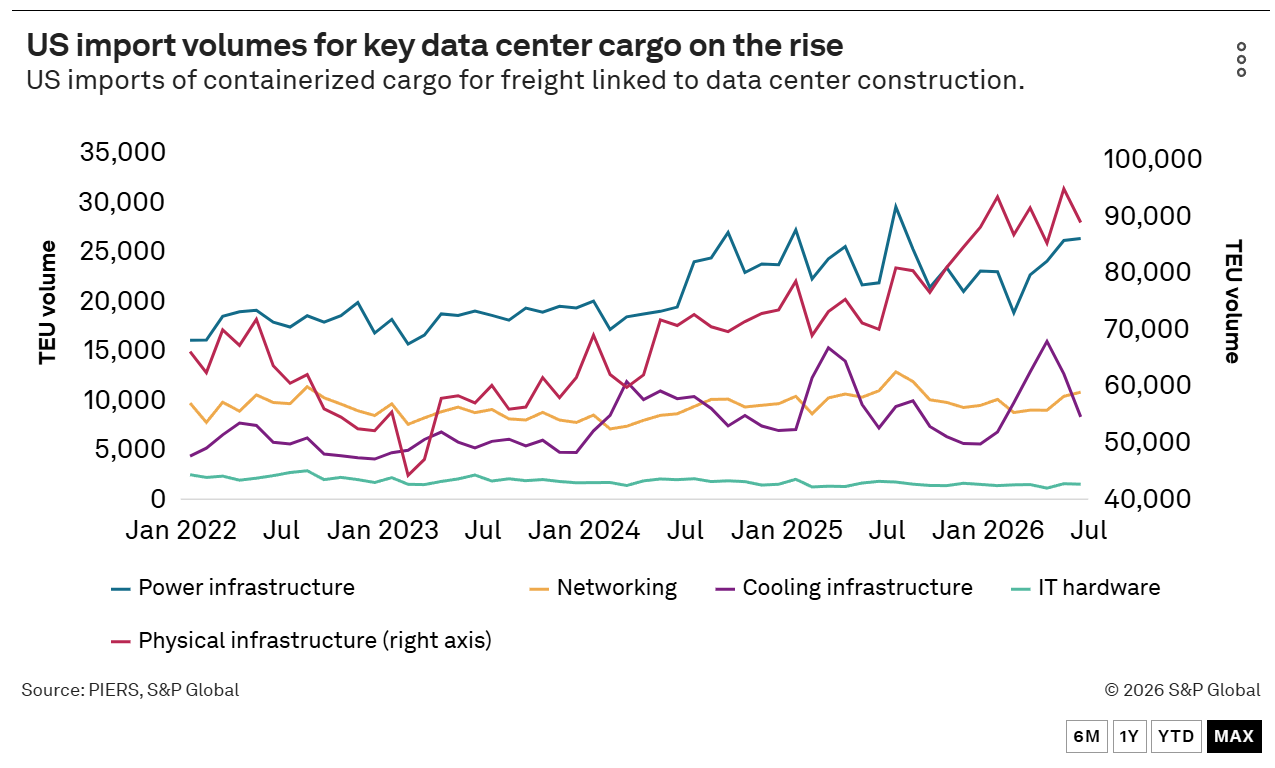
Citing a July 2026 report by the International Monetary Fund (IMF), Alan Murphy, founder of Sea-Intelligence Maritime Analysis, said carriers in the Asia-US trades must navigate a split between fast-growing tech center exports and softening consumer merchandise exports.
“According to the IMF report, trade momentum is heavily skewed, with AI hardware exporters experiencing massive growth surprises while traditional consumer hubs face softening demand,” Murphy said in his most recent Sunday Spotlight newsletter.
Data center opposition growing
However, the ongoing, seemingly unrestrained construction of AI data centers is no longer a given, with local resistance growing. According to S&P Global Energy, at least 64 projects in the US representing approximately 29 gigawatts of potential capacity demand have been canceled, rejected or withdrawn amid grassroots pressure.
Indeed, just on Tuesday, New York became the first state to implement a moratorium on large data centers, banning for one year the construction of facilities larger than 50 megawatts while state officials study the effects on the environment and public utilities. The state says it is fielding multiple proposals for data center projects “that could require massive amounts of energy and water to run and cool thousands of computer servers.”
Data center power demand growth in the US is forecast to average 13.5% per year from 2026 to 2030, according to S&P Global Energy.
“As data center development threatens to hike up utility bills, deplete our natural resources, and create uncertainty for New Yorkers, it’s my responsibility to take action...,” Gov. Kathy Hochul said in a statement.
Other states have shown displeasure with the data center buildout, with lawmakers in Maine, Georgia, Maryland, Michigan, Minnesota, New Hampshire, Oklahoma, Pennsylvania, South Carolina, Vermont and Virginia either announcing opposition or pursuing restrictions because of the huge amount of electricity the facilities consume.
‘Not a seasonal thing’
For now, data center buildouts are generating a surprising volume of US imports that show no sign of diminishing, certainly not in the coming few months.
The ports of Los Angeles and Long Beach, which account for about 50% of all US imports from Asia, according to PIERS, say that data center, industrial, infrastructure and all other products that cannot be classified as consumer imports account for 20% to 25% of their total imports.
Jon Monroe, who serves as an adviser to forwarders, said that while China’s advantage in the manufacturing of footwear, apparel and various consumer items has lessened, the production of data center and industrial inputs is centered there, so factories are rushing to expand their output.
“This is not a seasonal thing,” Monroe said. “It will be consistent for the next three years.”
Growing imports of these non-consumer products are reflected in US containerized imports from China. According to PIERS, China’s total exports to the US increased by an average of 32% in May and June combined on a year-over-year basis, compared with about an 18% increase from all of Asia. It is important to note that the year-over-year comparisons are based on 2025 import levels that plummeted in the wake of widespread tariffs the US implemented on trading partners in April 2025.
While the imports in the industrial sector helped keep spot rates elevated amid the retail-driven frontloading during the second quarter and into July, prices on the eastbound trans-Pacific have begun to soften of late, suggesting the momentum generated by that frontloading has started to lose steam.
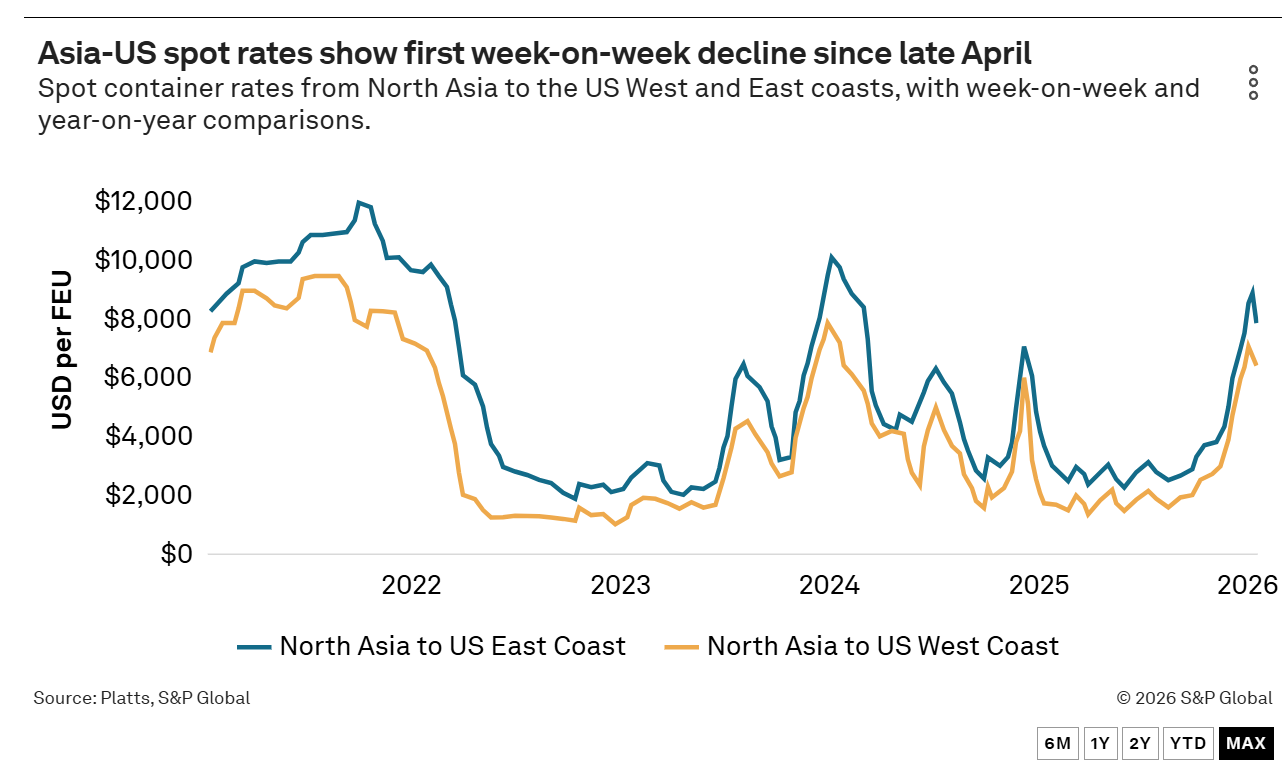
The spot rate from Asia to the US West Coast as of July 14 was $6,450 per FEU, down 12% on the week and the first week-over-week drop since late April, according to Platts, a sister company of the Journal of Commerce. The East Coast rate of $7,900/FEU was down 11% on the week.
Forwarders say some of the larger alliance carriers have extended the current rates through July 31.
A carrier source said spot rates to the West Coast “have calmed down and stabilized” as liners over the past month introduced extra-loader vessels to the trade lane. In order to fill the extra capacity, carriers are offering special discounts that have dropped spot rates to the low $6,000s/FEU, he said.
Nevertheless, the steady flow of industrial imports is keeping rates from collapsing.
“There are still some legs to this rally,” the carrier source said.