

The container shipping industry this year will manage to stay ahead of the rapidly building wave of excess capacity looming over ocean carriers as geopolitics, network disruptions and frontloading by shippers keep all vessels employed on major trade lanes.
But such is the volume of capacity coming online beyond 2026 that avoiding the jaws of excess supply will be difficult, with delivered tonnage likely to overwhelm the market, a Journal of Commerce webinar was told Thursday.
“It’s very hard to see carriers not being absolutely pressed with massive amounts of oversupply and chasing down marginal revenue towards marginal cost,” said Alan Murphy, CEO of Sea-Intelligence Maritime Analysis.
Ocean carriers have been in this position before. Toward the end of 2019, there was far more capacity coming online than was required and analysts were predicting a sharp drop in rates. Then came the pandemic and its accompanying global disruption, allowing the container shipping industry to bank operating profits of $500 billion over the next three years.
At the end of 2023, the once again heavily oversupplied carriers were predicting a dismal 2024 before the Houthi militants in Yemen began attacking ships in the Red Sea in support of Hamas after Israel’s invasion of Gaza. Shipping quickly switched to routes around southern Africa, with the longer transits absorbing 10% of global capacity.
Still, it is difficult to see carriers finding a get-out-of-jail-free card this time, with the order book fast approaching 40% of the in-service fleet.
Flood of incoming supply
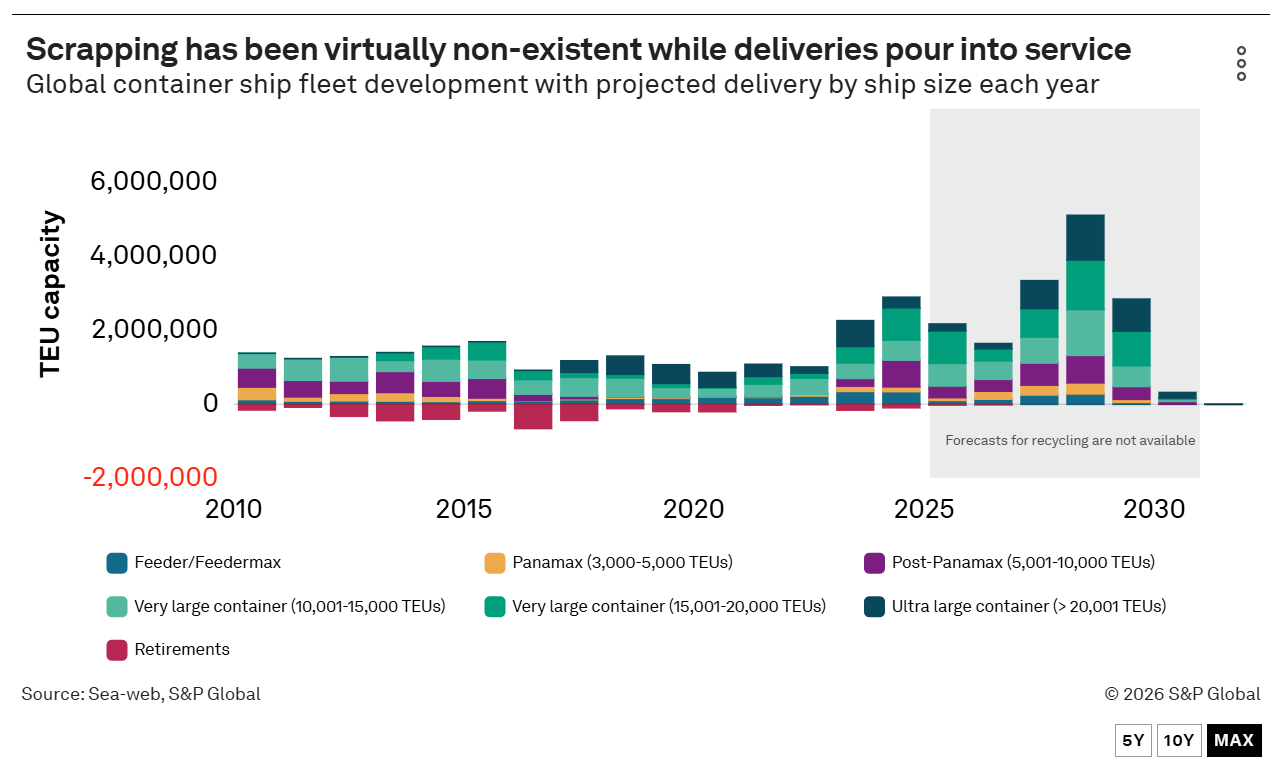
Total capacity on order is currently at 12.3 million TEUs, 37% of the current fleet, according to Sea-web, a sister company of the Journal of Commerce within S&P Global. Just over 1 million TEUs of capacity via ships over 10,000 TEUs is scheduled to be delivered this year, contributing to capacity growth of 4% amid initial market predictions for demand growth of 2% to 3% this year.
But the flood of incoming supply will be acutely felt by carriers over the next two years, with 2.3 million TEUs of capacity due for delivery in 2027 and 3.8 million TEUs in 2028.
The significant amount of capacity sailing into service will coincide with potentially normalizing Suez Canal transits, said Simon Heaney, senior manager of container research at maritime consultancy Drewry.
“As Suez transits normalize and carriers regain access to shorter voyage distances, effective supply will rise sharply,” Heaney said. “Combined with an expected 8.1% expansion of the global container ship fleet in 2027, this will exert substantial downward pressure on market balance.”
Maersk this week said it was routing its MECL service through the Red Sea and Suez Canal following the incident-free transit of the Majestic Maersk through the region this week as part of Gemini Cooperation’s AE15 offering. The carrier has called it “a gradual return” to Suez transits and said if the security situation deteriorates again, the services will revert to the Cape of Good Hope route.
Murphy, speaking on the webinar, used Sea-Intelligence data to forecast the extent of the overcapacity facing the market should the Suez and Red Sea route remain out of bounds over the next three years, and if it was fully normalized next year.
“The assumptions that we’ve made is global demand will grow at 4% from 2027 to 2030,” he said. “It has grown in the last few years at 5.5%, and that is higher than the long-term average of 3%. We also assume 3% of the capacity will be scrapped.”
Assuming there was no widescale return to Suez transits within the next three years and vessels continued to sail around Africa, Murphy said excess capacity would be between 8% and 10%.
“To put that into perspective, during the freight rate wars of 2014 to 2017, we had 10% excess capacity, so even at this relatively modest approach to supply and demand, we are heading into what looks like dire straits,” he said.
“But what if in 2027, we see a return to Suez Canal and the 10% of capacity that was soaked up by going around Africa is returned to the market? Then suddenly, we’re looking at excess capacity of 20%,” Murphy said.
The analyst took the assumptions even further to arrive at a “horror scenario” where there was 3% demand growth, no scrapping and a return to the Suez Canal.
“Then we’re in a real nightmare for the carriers with massive oversupply exceeding 25%,” he said.
Akhil Nair, global head of forwarding at Hong Kong-based Logisteed, said the market consensus six months ago was that in the heavily oversupplied container shipping business, a resumption of Suez transits would return so much capacity that it would quickly lead to a rate collapse.
That logic no longer applies, with the Middle East war that has effectively closed the Strait of Hormuz changing the dynamic, Nair wrote in a LinkedIn post this week.
He said the rate-crash thesis assumed the disruption was singular and reversible. Red Sea rerouting added 10 to 14 days on Asia-Europe strings and absorbed 15% to 20% of effective global capacity through distance alone.
“That capacity was always going to return as vessels normalized back through Suez,” Nair said. “Carriers knew it, shippers knew it, and the forward rate curve reflected it.”
A ‘cost structure problem’
But Nair said the closure of the Strait of Hormuz presented a different class of risk. Approximately 21 million barrels of oil a day moved through Hormuz, about 20% of global petroleum, plus a significant share of liquefied natural gas.
“A sustained closure [of Hormuz], or even a credible threat of one, does not just reroute tonnage,” he said. “It reprices insurance and energy, which reprices bunkers, which reprices every freight rate on every lane at once ... That is not a routing problem. It is a cost structure problem.”
Carriers managed the Red Sea disruption through blank sailings and slow steaming, discipline tools that a consolidated market of 12 to 13 major carriers was able to deploy.
The closure of Hormuz was different, however, with Nair noting that no amount of capacity discipline could defend against a bunker fuel spike that permeated globally to all trades.
“This is why the reopening [of the Red Sea/Suez route] will not do what the bears expect,” he said, adding that the cautious return of carriers to the Red Sea will have little effect on prices in a market where the Container Trades Statistics (CTS) global rate index was currently up 22% year over year.
“Bringing a service back into a market whose cost floor is being reset by Hormuz does not crash rates, it simply tests carrier discipline against a higher bunker base,” Nair said.