

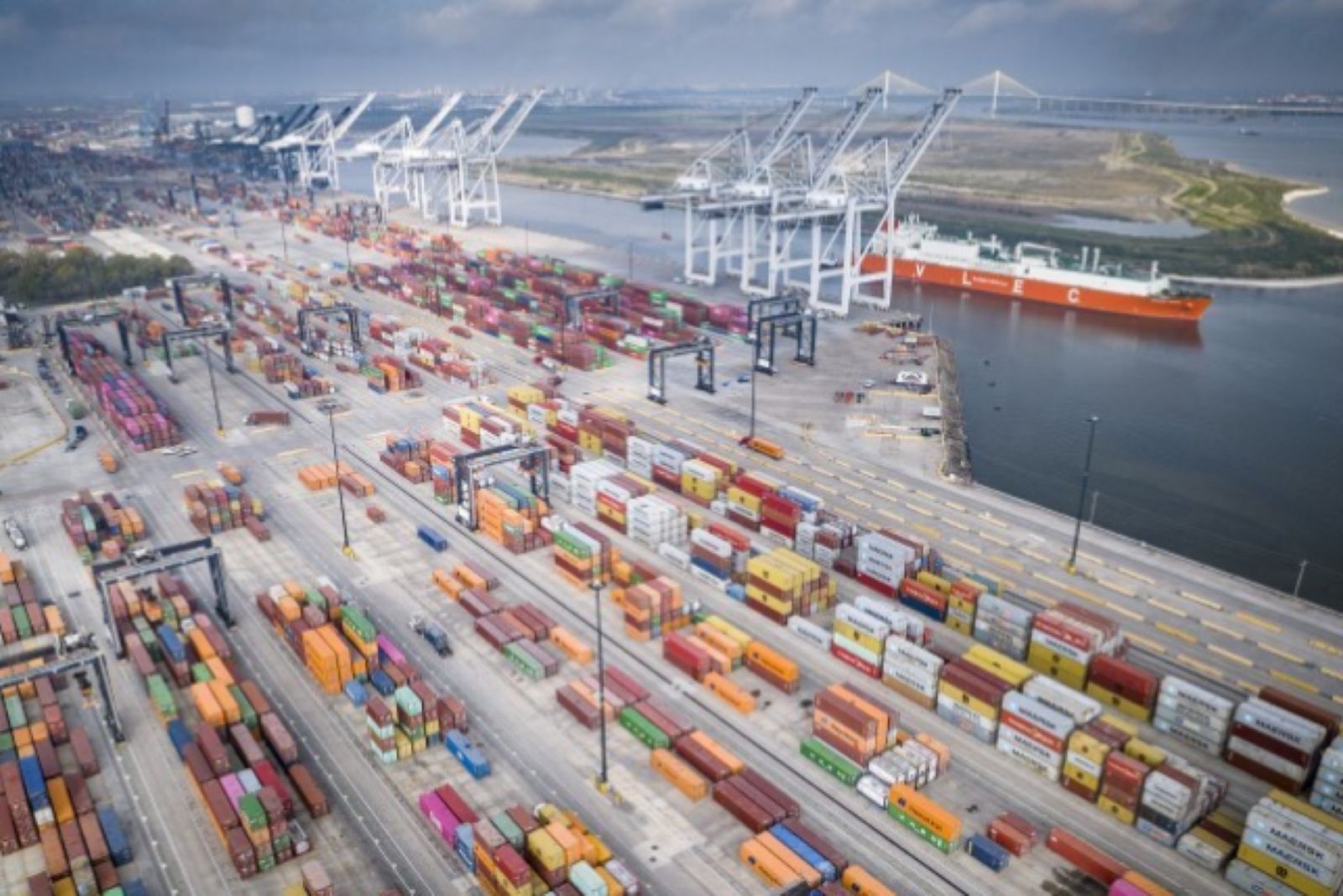
The Port of Houston is doing early work on what would be its third container terminal, a development the port says will be needed in a decade and will eventually triple its total handling capacity.
A group of federal agencies that includes the US Army Corps of Engineers earlier this month designated the Barbours Cut North Expansion project submitted by the Port of Houston Authority (POHA) as eligible for expedited review under a 2015 permitting law known as the FAST Act.
The project would encompass 318 acres at a site on Spilman Island, a dredge placement site, to the north of the existing Barbours Cut terminal. Port of Houston’s Chief Operating Officer Eric Casey told the Journal of Commerce the permit application would allow POHA to do geotechnical and design work on Spilman Island for a third container terminal.
Spilman Island, though, is just one site the port is considering for its third container terminal, Casey said, adding the location still requires commercial review. While the port said the third terminal will not be needed for a decade, Casey said work needs to start now to be ready for future volume growth.
“We had to file the permit because of the length of time it takes to get it and then to do the engineering and other studies,” he said. “Our terminal three is in the advanced planning because we know we are going to continue to grow. We never want to be a bottleneck for the maritime industry.”
Future planning for a third container terminal comes amid the ongoing $2 billion development of Houston’s two existing terminals. In March, Houston began the third phase of expansion of its Bayport container terminal, which handles most of the trans-Pacific Asia services coming into the Gulf Coast.
That expansion will add two new berths to Bayport — allowing it to handle five super-post-Panamax ships simultaneously — along with another 100 acres of yard space. The expansion is set to be completed by 2028.
The Barbours Cut terminal is also undergoing a series of renovation projects through 2028 that include strengthening two of its berths and installing larger cranes for super-post-Panamax ships.
At full buildout, the Bayport and Barbours Cut will have nominal capacity for handling 8 million TEUs per year. Casey said the third terminal, which will be delivered in phases, would be capable of 4 million TEUs at full capacity.
“We have the capacity right now, and we’ve already started construction to double the capacity at our current terminals,” Casey said. “We’re not in a rush, but at the same time, we can’t rest on our laurels.”
“In 10 years, we’re going to want to have phase one of the [third] terminal built,” he added. “We’re looking at potentially around a 4 million-TEU terminal.”
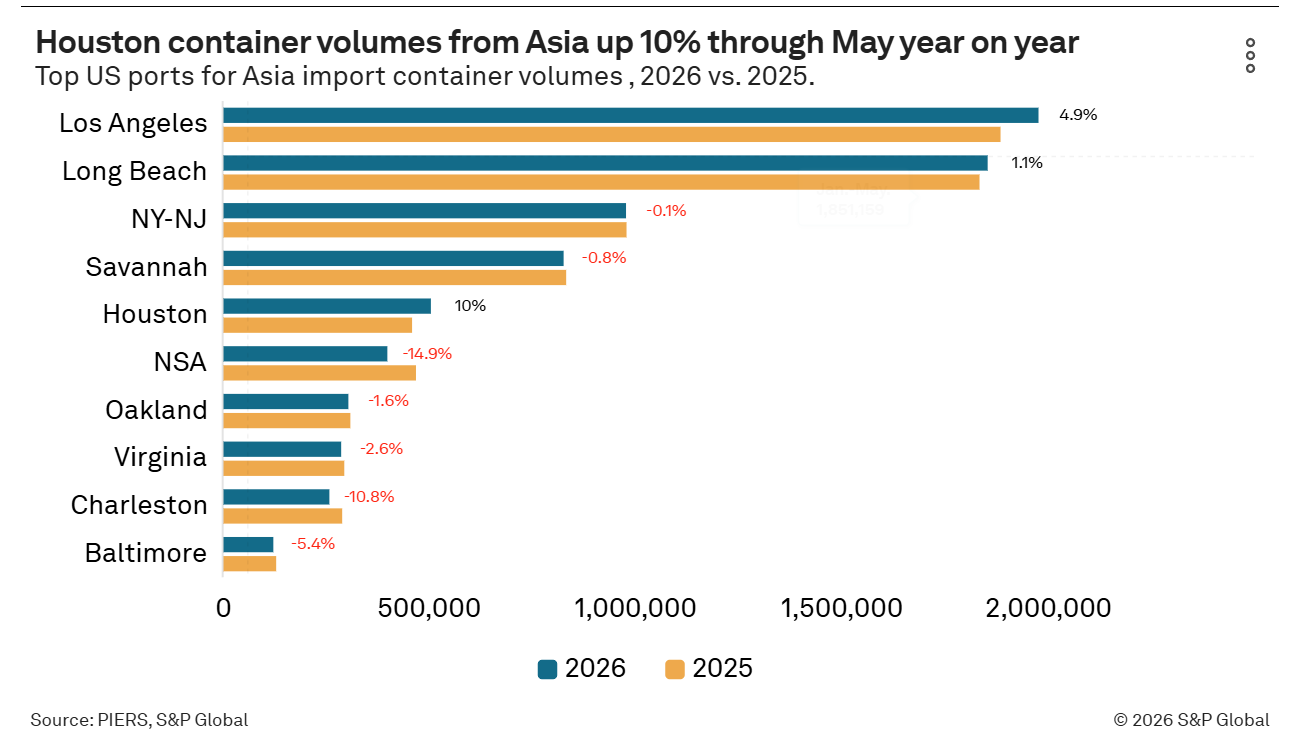
Year to date through May, Houston handled 502,387 TEUs in container imports from Asia, up 10% from the same period in 2025, according to PIERS, a sister product of the Journal of Commerce within S&P Global.
Readying for deeper channel
Casey said the third terminal should be ready around the time Houston expects it to have begun dredging its main ship channel down to a big ship depth of 55 feet, or possibly more.
In October 2025, the port completed its portion of the work on Project 11, the three-year project to widen the Houston Ship Channel to allow for easier two-way vessel traffic, and to dredge portions of the channel down to a 46-foot depth.
While depth restrictions and sporadic shoaling limit full loading of a ship in Houston, Project 11 has allowed more large ships to call the port in recent months. Through the first half of 2026, nine container ships over 10,000 TEUs in capacity have called Houston, according to Sea-web, a sister company of the Journal of Commerce. That compares with four in the second half of 2025.
Casey said the port saw approximately an 11% increase in deep-draft vessels of all types, including tankers, transit the ship channel in May. That number will eventually increase with the Project 12 dredging.
“The terminal is going to be designed for our P12 program, so we’re going to accommodate the really big ocean-going vessels and not have any kind of limitations,” Casey said.
While Port Houston had to essentially piece together the Bayport terminal from both its own land and a former Sealand marine terminal, Casey said Port Houston wants the third terminal to be more integrated with the region’s road networks.
The Spilman Island location is across the ship channel from the Cedar Port Industrial Park, a 15,000-acre logistics, warehousing and distribution site in Baytown, Texas. Most of Cedar Port’s customers must rely on trucking from the port’s container terminals over the Fred Hartman Bridge.
Casey said the Baytown region accounts for about 9% of the cargo demand at the Houston container terminals. To that end, the port is working with Cedar Port’s shippers on how it can optimize cargo flow from a third terminal, particularly in a region that can be choked with traffic.
Cedar Port “is absolutely in our planning,” Casey said. “We’ve reached out to our customers that are over there. We’ve reached out to the truckers, and we’re looking at what makes the most sense to maximize value and minimize choke points.”