

Rate hikes implemented this week by ocean carriers on the eastbound trans-Pacific may be the last chance for liners to keep prices at their current 2026 highs — at least for US West Coast business — as the launch of new weekly services and the addition of some extra-loaders begin to inject fresh capacity into the trade lane.
Some market observers say spot rates to the West Coast could even start to soften this week after a four-month bull run driven by cargo frontloading and higher bunker fuel prices linked to the war in the Middle East.
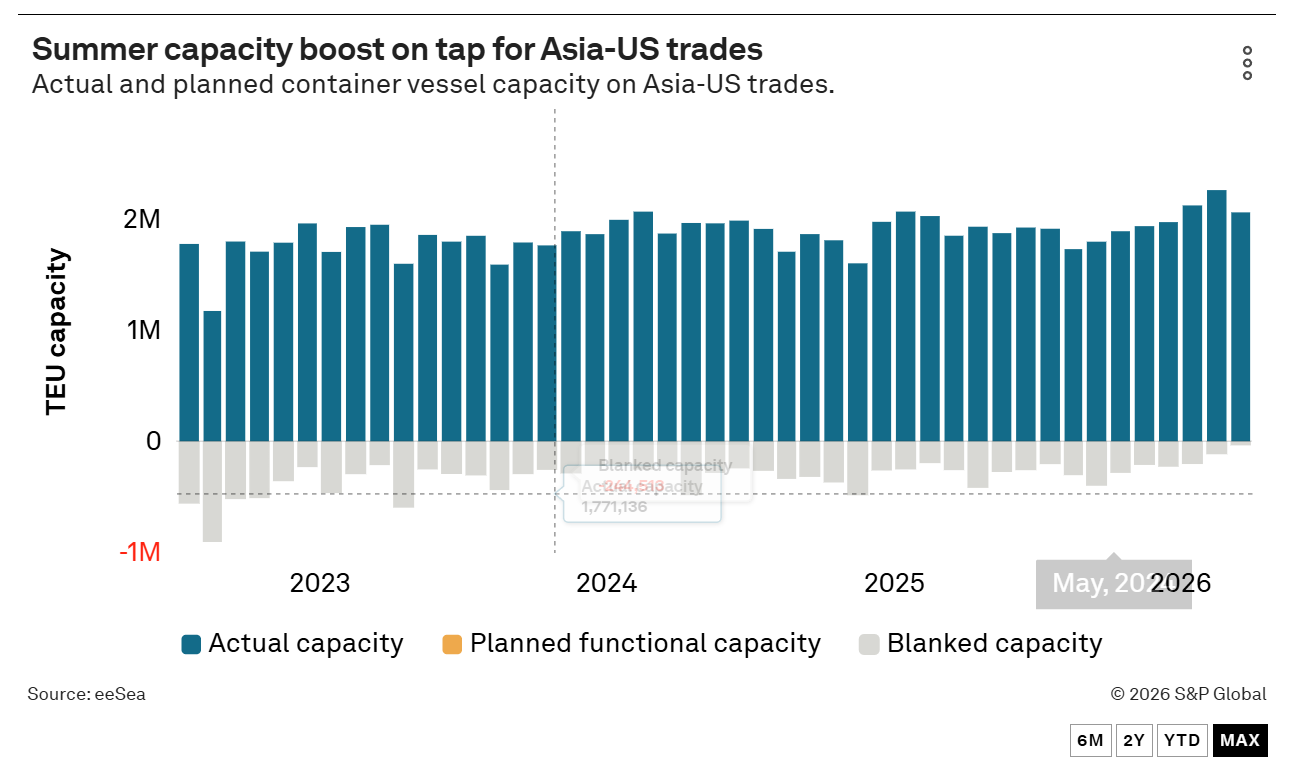
Indeed, data shows a capacity boost is coming on the eastbound trans-Pacific. Xeneta’s eeSea indicates that July’s actual capacity from Asia to the US will rise 7.5% from June, with another 6.5% bump in planned capacity expected in August. For the West Coast alone, capacity is due to climb 12% in July month over month.
“The rates are holding for the most part now because of the cargo spike from all of the frontloading, but the West Coast spot rate could come down after the July 4 holiday,” Christian Sur, executive director of global sales at the forwarder Glovis America, told the Journal of Commerce. “We’ve already gotten some special [discount] rates from carriers.”
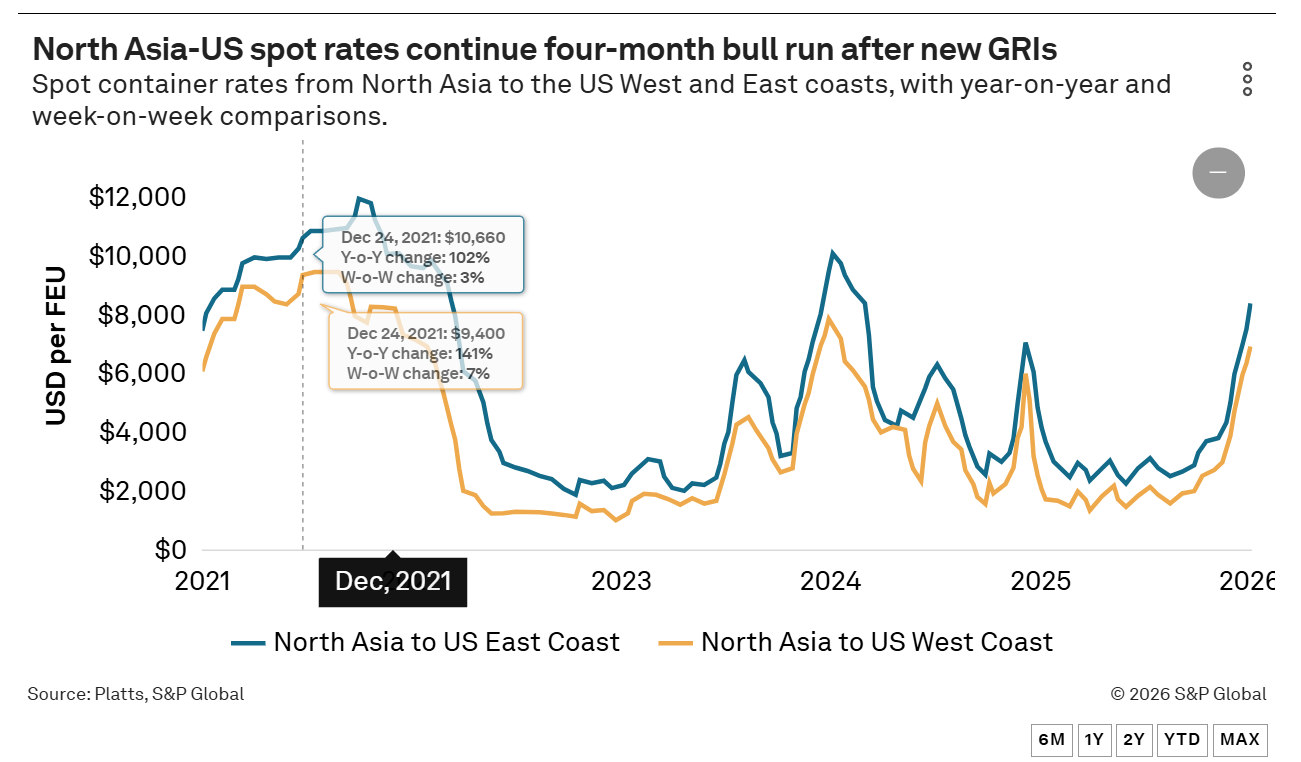
Spot rates in the eastbound trans-Pacific spiked Wednesday to fresh highs for the year as carriers levied previously announced general rate increases (GRIs) of about $800 to $1,000 per FEU.
The North Asia-West Coast spot rate as of July 1 was $6,967 per FEU as assessed by Platts, a sister company of the Journal of Commerce within S&P Global. That’s up 9% on the week.
However, at least a half-dozen carriers implemented GRIs that took effect on Wednesday to push their West Coast spot rates closer to $7,500 to $7,800 per FEU, forwarders said.
The North Asia-East Coast spot rate as of July 1 was $8,433/FEU, according to Platts, up 12% on the week and the highest since August 2024. Forwarders said carrier rate hikes showed new rates on the trade lane ranging from $9,000/FEU to $9,300/FEU.
West Coast spot rates peaking?
Vessel space from Asia to the West Coast is already beginning to loosen up due to the introduction of extra-loaders and new weekly services from Mediterranean Shipping Co. and Maersk.
“Personally, I think the market has reached a peak,” a carrier executive told the Journal of Commerce.
Data from eeSea shows Asia-US capacity will climb to 2.13 million TEUs in July, up from 1.98 million TEUs in June. A further boost to 2.27 million TEUs is expected in August.
An industry consultant who formerly managed the logistics departments for national retailers said the latest round of rate hikes can be tied to anticipated tariff increases on July 24 that led to an extended period of frontloading of fall and holiday merchandise. But he said the gains are temporary.
“A lot of BCOs [beneficial cargo owners] are pushing to get cargo loaded ASAP,” the source said. “Carriers are taking advantage of this now because it will not last. Will there even be a fall peak?”
East Coast GRIs may ‘stick’ longer
Forwarders say East Coast spot rates should remain elevated well into July because carriers are not adding capacity to that lane.
“The East Coast is tight, so those rates should stick,” Jon Monroe, who serves as an adviser to forwarders, told the Journal of Commerce.
Due to the longer distances from Asia to the East Coast and water depth limits along the Panama Canal, carriers are not likely to add entire strings with large ships, although they could deploy extra-loader vessels if demand remains high, Glovis’ Sur said.
Rachel Shames, vice president of pricing and procurement at the forwarder CV International, said vessel space is tight right now to the East Coast and to Houston, which is keeping rates elevated. But that may not last much longer.
“Some industry sources say the rates should plateau in July, so we should see some relief on the GRIs,” Shames said.
BCOs and forwarders with fixed-rate, or named account, clients who have been paying high floating bunker fuel surcharges since the war in the Middle East began on Feb. 28 may also experience some relief on their emergency bunker adjustment factors, Shames said.
“For those on a monthly reset, there should be a modest increase or maybe a slight reduction,” she said.
Trans-Pacific carriers have filed the required 30-day notice with US maritime regulators for yet another GRI on July 15, meaning the next two weeks will determine if customers should anticipate still higher spot rates, the carrier executive said.
“If the July 1 GRI doesn’t hold, it’s bad news for July 15,” the source said.