

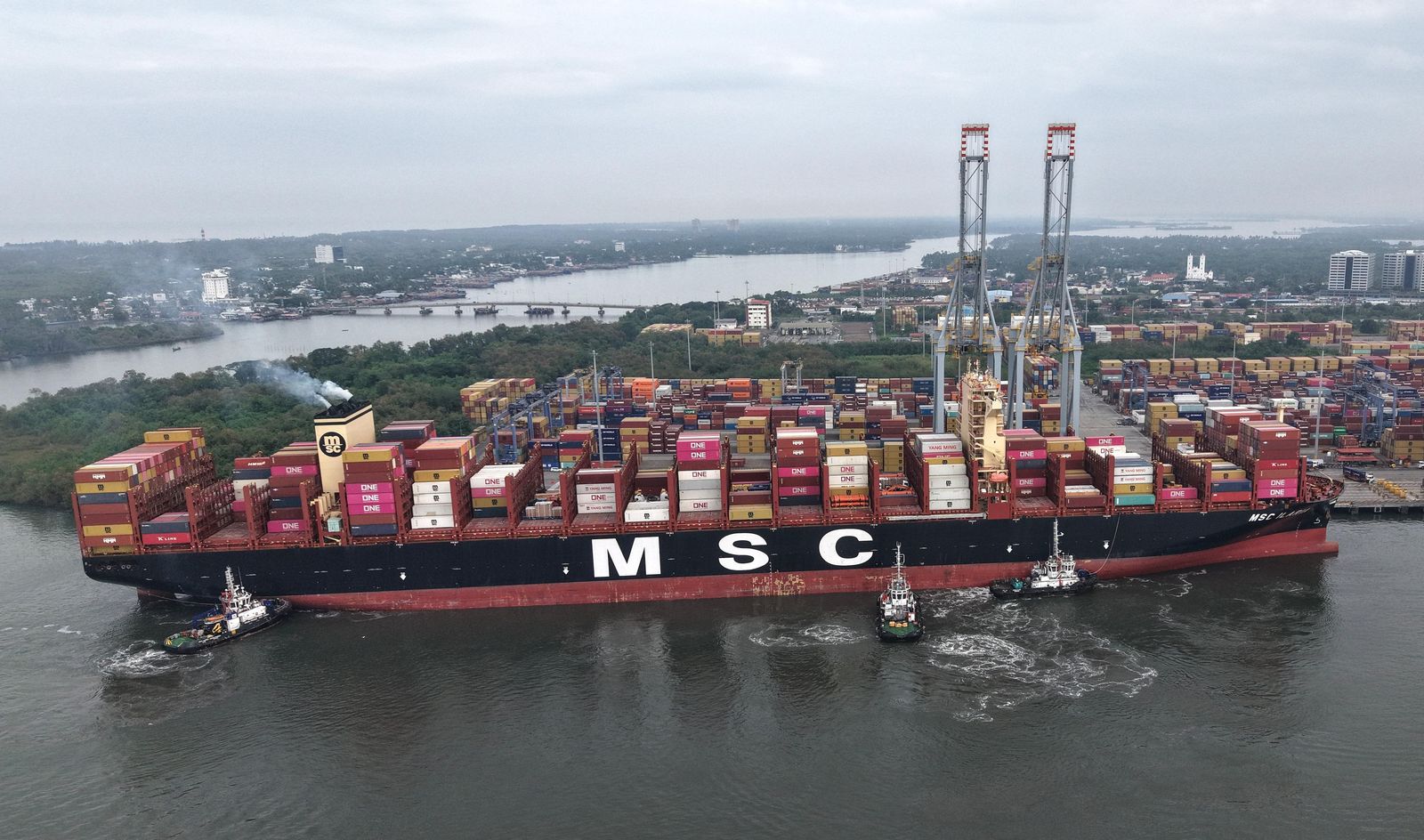
The persistent dual pressures of demand headwinds and geopolitical uncertainty seem to have begun pushing container lines to implement capacity cuts on Indian westbound trades.
Signaling that approach, Mediterranean Shipping Co. has withdrawn its “Indus Express” service between West India and the US East Coast, one of the two strings the carrier has long operated on the trade lane.
The outgoing service featured calls at Port Qasim (Karachi), Nhava Sheva, Mundra, Caucedo (Dominican Republic), Freeport, Savannah, Charleston, Norfolk, Baltimore and New York.
“Due to routing changes, the Indus Express service is discontinued, effective immediately,” MSC said in a customer advisory that was seen by the Journal of Commerce. “MSC Pratiti will be the final vessel operating under this service.”
The Pratiti is currently scheduled to depart India’s Mundra Port on June 4 and arrive in New York on July 13, available schedule data shows.
While it is believed that India-USEC bookings will be redirected to MSC’s “Indusa” service on the same trade lane, India-South America coverage served via transshipment is expected to face short-term disruption.
“As a result [of the Indus Express suspension], do not confirm bookings or issue quotations for India to SAEC/SAWC [SA East/West coasts] until the new routings and tier levels are communicated,” the Geneva-based liner told clients in its advisory.
Indusa vessels have had an average combined space allocation of 1,800 to 2,000 TEUs per call out of West India (Nhava Sheva/Mundra), local forwarder sources say.
MSC previously dropped the complementary “Indus 2” loop it had added in August 2021 to take advantage of the pandemic-linked demand upswing.
“MSC uses rampant ad-hoc strategies in its vessel operations to keep moving cargo, so its volumes are unlikely to be affected much,” said an industry observer who didn’t want to be identified.
With little demand growth, the India-USEC market remains significantly oversupplied. And Maersk’s planned upsizing of tonnage on its “MECL” loop, expected to occur this month, may exacerbate the overhang of capacity on the trade lane and keep rates volatile, sources believe.
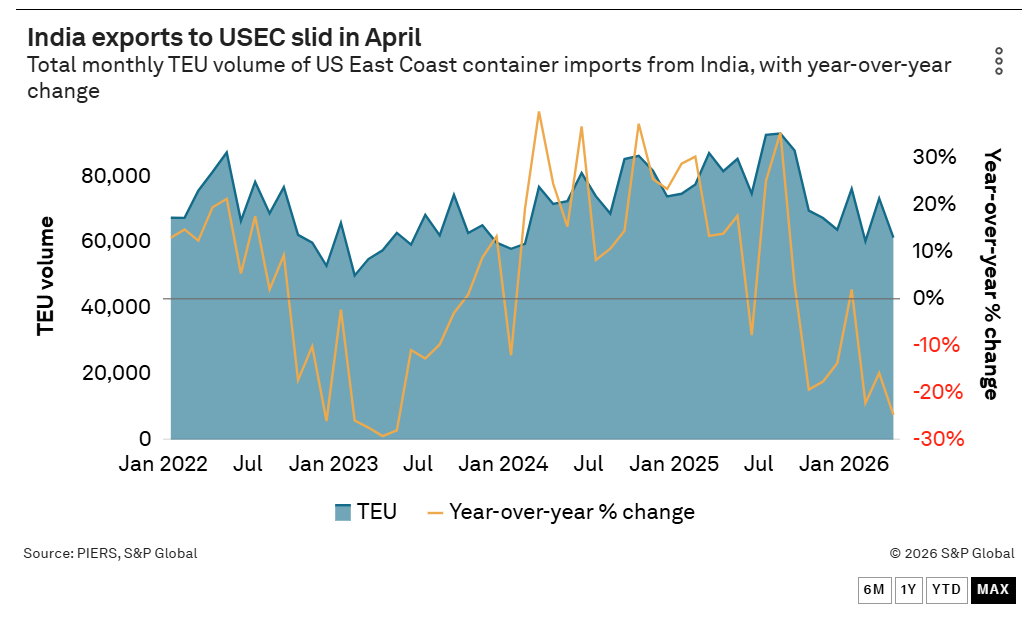
The end of the Indus Express service comes as India-to-USEC container volumes in April, the latest data available, fell to 61,500 TEUs, down 25% year over year, according to PIERS, a sister product of the Journal of Commerce within S&P Global. That was also down from 73,420 TEUs in March.
Meanwhile, India to USEC booking rates have been stuck in the range of $2,000 to $2,500 per FEU, varying from carrier to carrier, over the past month, according to industry data. As the supply-demand picture slightly alters, forwarders expect leading carriers to attempt modest rate hikes in the coming weeks. Carrier increase plans already lined up include a $1,650-per-container peak season surcharge by Maersk from June 10 and a $1,000-per-container general rate increase from Hapag-Lloyd on June 15.
Platts, a sister company of the Journal of Commerce, assessed India-USEC spot rates at $2,200 per FEU as of June 1, indicating little change on the week.