

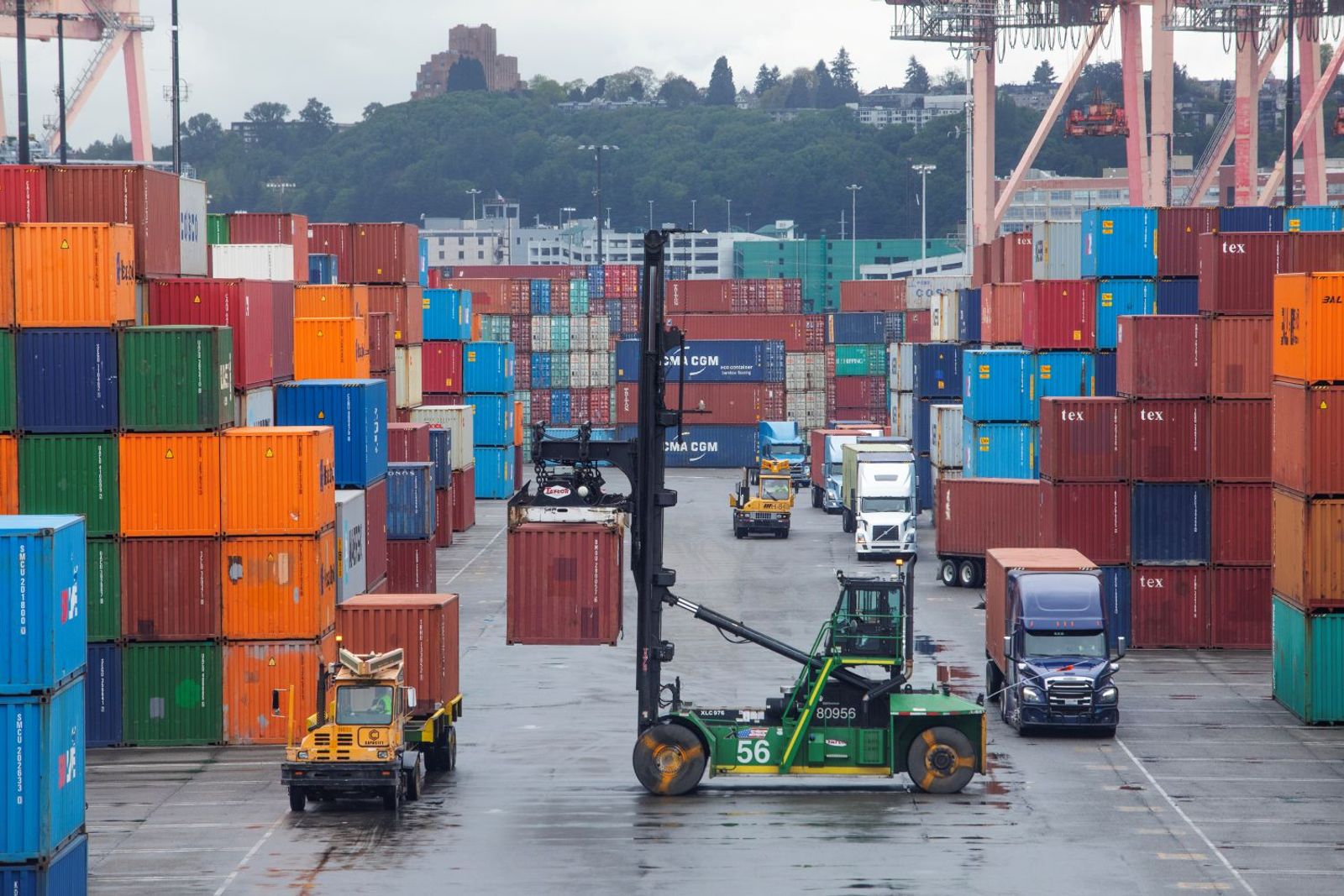
The Northwest Seaport Alliance of Seattle and Tacoma (NWSA) wants to take a more active role in managing cargo handling, a move that would allow it to perform some functions as an operator at some of its marine terminals while maintaining its traditional landlord role at other terminals.
Alliance CEO John Wolfe said such a hybrid model, a mixture of operating and landlord-leased terminals, would allow the port to be more responsive and bring uniformity among its two container terminals in Seattle and three in Tacoma. Seeing its import market share bleed to Southern California and over the northern border to Canada, the alliance is looking for new ways to set itself apart on the competitive West Coast of North America.
“There is an opportunity for us where we can draw closer to the operation so we can get a more consistent, reliable import and export operation, and that’s what our customers expect of us,” Wolfe told the Journal of Commerce.
By standardizing as much of NWSA’s container terminal operations as possible — such as trucker appointment systems, ERDs (earliest return dates) of containers to the terminals, and expediting the movement of containers upon discharge from the vessel to on-dock intermodal trains — the port will improve its time-to-market advantage over the other West Coast ports.
“We can separate ourselves from the typical landlord port,” Wolfe said.
West Coast ports, as well as New York-New Jersey, are landlord ports that build the terminals and lease them to private sector terminal operators. Ports along the Southeast US coast and in Houston are operating ports, meaning they manage the facilities and hire the International Longshoremen’s Association (ILA) labor.
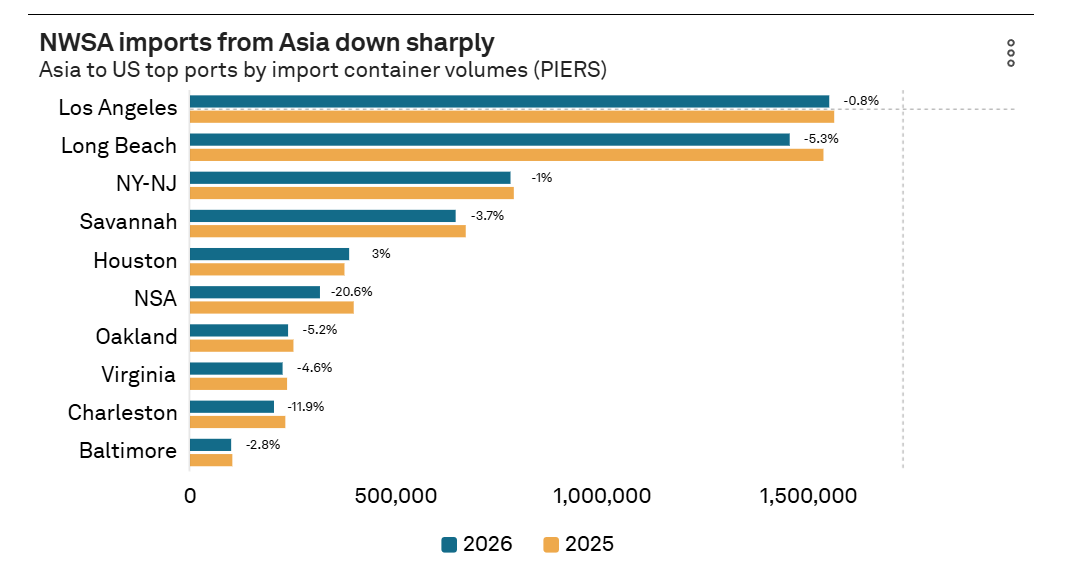
The NWSA is struggling with declining import volumes that have dropped much more than volumes at other West Coast ports through the first four months of 2026. Imports in Seattle-Tacoma fell 20.6% year over year through April versus declines of 0.8% in Los Angeles, 5.3% in Long Beach and 5.2% in Oakland, according to PIERS, a sister company of the Journal of Commerce within S&P Global.
By contrast, Western Canadian ports experienced import gains in the first quarter — 9% in Vancouver and 7.8% in Prince Rupert, according to Sea-Intelligence Maritime Analysis.
All the ports on North America’s West Coast must remove friction in their supply chains and speed their delivery of containers to inland destinations due to the changing nature of imports from Asia, said Dan Smith, principal at the consulting firm Tioga Group. Exports from China and North Asia are shifting steadily to Southeast Asia and the Indian subcontinent, which improves the competitive position of those ports, Smith said.
“Part of what’s going on is a loss of West Coast market share to the Southeast and Gulf ports,” he said. “There’s nothing the West Coast can do about those geopolitical factors.”
Intermodal rail speed to Chicago is crucial
The principal US destination for intermodal cargo moving through North American West Coast ports is Chicago. Jeff Bellerud, NWSA’s chief operating officer, said the Pacific Northwest already has a vessel transit time advantage from Asia over Los Angeles-Long Beach due to the shorter ocean distance. NWSA’s efforts now are directed at reducing container dwell times on the terminals and the time it takes to work the ships and load and send out eastbound intermodal trains from the on-dock rail yards.
The NWSA is collaborating with carriers to stow high-priority rail-destined containers on vessels in Asia so they are the first to be discharged from the ships when they dock in Seattle-Tacoma. Port staff is also working with the individual terminal operators to prioritize the movement of intermodal containers.
Wolfe said Husky Terminal in Tacoma provides a good example of the port’s evolving role as a hybrid landlord-operating port. Husky hires the International Longshore and Warehouse Union (ILWU) labor that works the vessel, yard and gate. The port authority has an arrangement with the IILWU to dispatch the dockworkers to the on-dock rail operation to ensure there is sufficient labor there.
“It’s a strong partnership that results in that speed-to-market that’s so important,” Wolfe said. “As we look to the future, we’re going to continue to go to our terminal operators and work with them in partnership to provide best-in-class service.”
Mark Sisson, vice president and senior port planning analyst at the infrastructure engineering and consulting firm AECOM, said that from an operational perspective, it makes sense for the terminal to handle the vessel, yard and gate operations and for the port to work the rail operation if that’s what’s necessary to get intermodal trains to depart quicker.
“But they will need buy-in from all five terminals [in Seattle and Tacoma],” Sisson said. “I assume the private terminal operators like to be doing what they’re doing. To give away activity they’ve historically controlled, to give this away to somebody else, it seems like a difficult sell.”
Getting buy-in from all NWSA terminals on gate hours is another issue the port is struggling with. SSA Marine, which operates the two container terminals in Seattle, in April began to close one of the facilities on Mondays and the other on Fridays, an arrangement that is continuing into June. Port managers told SSA that is not the message NWSA wants to send to importers, exporters and truckers when it comes to customer service. The port wants all of its container terminals to offer consistent day shifts five days each week. SSA declined to comment this week.
Smith said SSA dropped one day shift at each of its terminals because cargo volumes are down, and it will be difficult for the port to convince SSA to re-instate the gates unless there is a clear indication new trans-Pacific vessel strings will develop and volumes will increase.
“It will be tough to convince SSA to stay open if they can’t recover their costs,” Tioga Group’s Smith said.
Single port-wide trucker appointment system a goal
The NWSA is also working with its terminal operators to participate in a single port-wide approach to trucker appointments. The terminals all participate in eModal’s CargoSprint product, but each of the terminals uses a slightly different functionality, Bellerud said. That means truckers and their customers have to search five different screens to find what they are looking for, he said.
Smith, however, said trucker appointment systems are an issue for all West Coast ports because the trucking community has one view of what appointments are meant to accomplish and the terminal operators come at the issue from an entirely different perspective.
The terminals see appointment systems as a way to manage truck traffic by leveling it off throughout the day. Truckers want a more flexible appointment system that recognizes the fact that traffic conditions and delays within the supply chain frequently make it difficult for drivers to keep to their appointed time. They want the flexibility to immediately re-book their arrival on the same day when those delays occur, Smith said.
“Yes, it would be nice to standardize them or have them on one portal, but a higher priority is actually getting more flexibility into the appointment systems,” he said.