


A demand recovery on the trans-Atlantic westbound trade that followed a lackluster first quarter has begun to slow, with the sharply higher rates flattening over the past two weeks.
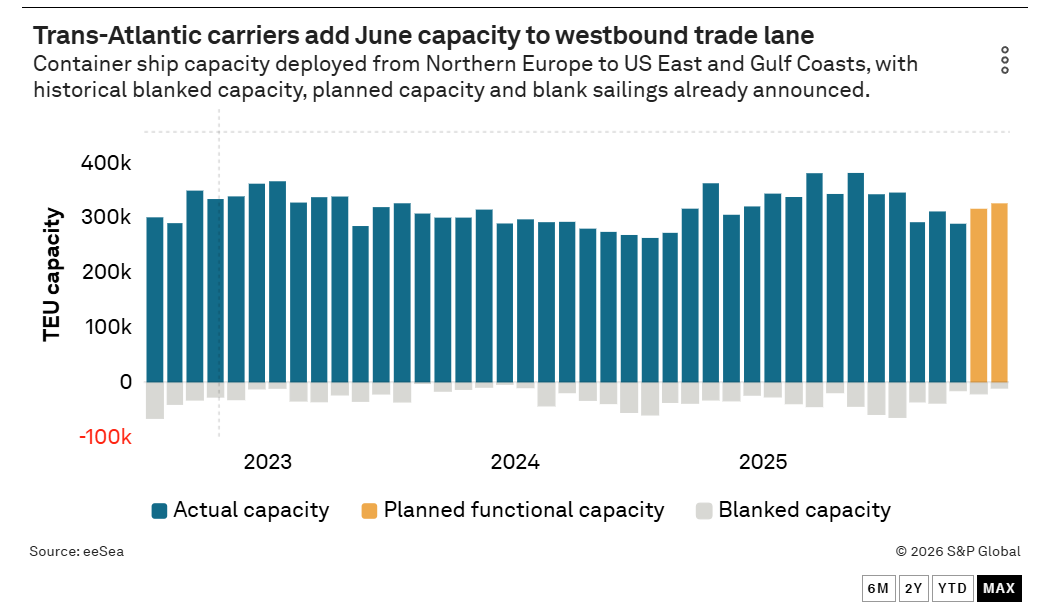
But the supply-demand picture is confusing. From a capacity perspective, expectations of a weakening market were not reflected in June’s vessel deployment plans by ocean carriers. Data from Xeneta’s eeSea shows planned capacity on the North Europe-US East Coast westbound trade in June will be 327,860 TEUs, up 10,000 TEUs from May.
Yet US imports in April, the latest available data from PIERS, a sister company of the Journal of Commerce within S&P Global, show volume declining 11% year over year at 185,960 TEUs following a 2.8% drop in March.
Spot rates on the corridor reached their highest level of the year in the first half of May, but there has been little upward movement since then, according to most rate indexes.
North Europe to USEC spot rates have been stuck at $2,100 per FEU since the first week of May, although that rate is up 60% from late March, according to Platts, a sister company of the Journal of Commerce. Drewry’s World Container Index this week was at $2,453/FEU for the trade lane, up 65% compared with the last week of March.
There are mixed industry views on what to expect from US import demand in June, although Hapag-Lloyd holds a positive view of the market heading into summer.
“The projection for June is pretty good ... it’s coming from all different industries, excluding forestry,” a spokesperson for the carrier told the Journal of Commerce Wednesday.
“Since May last year rates have been going down and a recovery was urgently needed,” the spokesperson added. “We saw a good March and a good April with strong volume growth, and the second half of May was a bit softer.”
Philip Damas, managing director and head of Drewry Supply Chain Advisors, said the latest data reflected a moderating market.
“We are not aware of strong demand flows on this route now; June is not typically a strong month for trans-Atlantic traffic,” Damas said. “We forecast a reduction in spot rates from Northern Europe to the US East Coast in June, ending the latest upswing period for spot rates.”
Westbound vessels ‘getting lighter’
Peter Sand, chief analyst at rate benchmarking platform Xeneta, also highlighted a weakening trans-Atlantic market.
“The carriers pulled capacity in January and convinced shippers that the market was tight,” he said. “[Capacity] is mostly back now and weak demand means there is no tight market on the trans-Atlantic.”
An ocean freight executive at a global forwarder agreed that the market was softening after a strong couple of months.
“We already see that vessels are getting lighter again and expect a calm summer,” the source told the Journal of Commerce.
The executive said several of the forwarder’s customers had shipped higher volumes than usual over the past two months “for different reasons.”
“Some customers said it was because of uncertainty over future Donald Trump and US Federal Reserve decisions,” he said. “Others said demand was returning to more normal in US markets and some people even talked about a shipment run due to the soccer World Cup.”
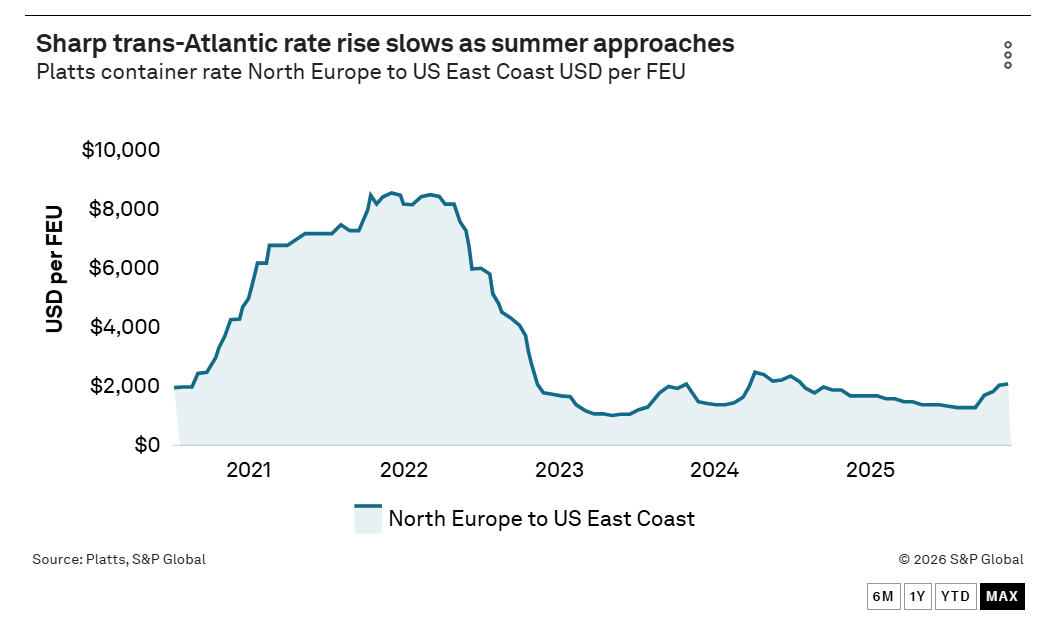
Damas said the strong spot rate increases on the trans-Atlantic that extended into May were mostly due to capacity reductions by the Ocean Alliance and higher bunker fuel charges.
Meanwhile, very low-sulfur fuel oil (VLSFO) bunker prices in Rotterdam are currently trading at $725/metric ton, a 48% premium compared with the Feb. 27 price just before the war in the Middle East began, according to data from Ship & Bunker.
At the other end of the trans-Atlantic trade lane, VLSFO in New York is trading at $794/metric ton after hitting a record high of $862/metric ton on May 5. The current price is 50% higher since the start of the war, Ship & Bunker data shows.