


Fast-rising fuel costs and a long-awaited uptick in demand are pushing less-than-truckload (LTL) pricing toward record highs, adding to shipper supply chain costs.
Even if fuel costs drop in coming weeks, shippers shouldn’t expect LTL rates to follow.
Both the TD Cowen/AFS LTL Freight Index and the US long-haul LTL producer price index (PPI) last week jumped to record highs, with no sign of decline ahead. Anecdotal reports show daily shipment counts turning north after a long decline in 2024 and 2025.
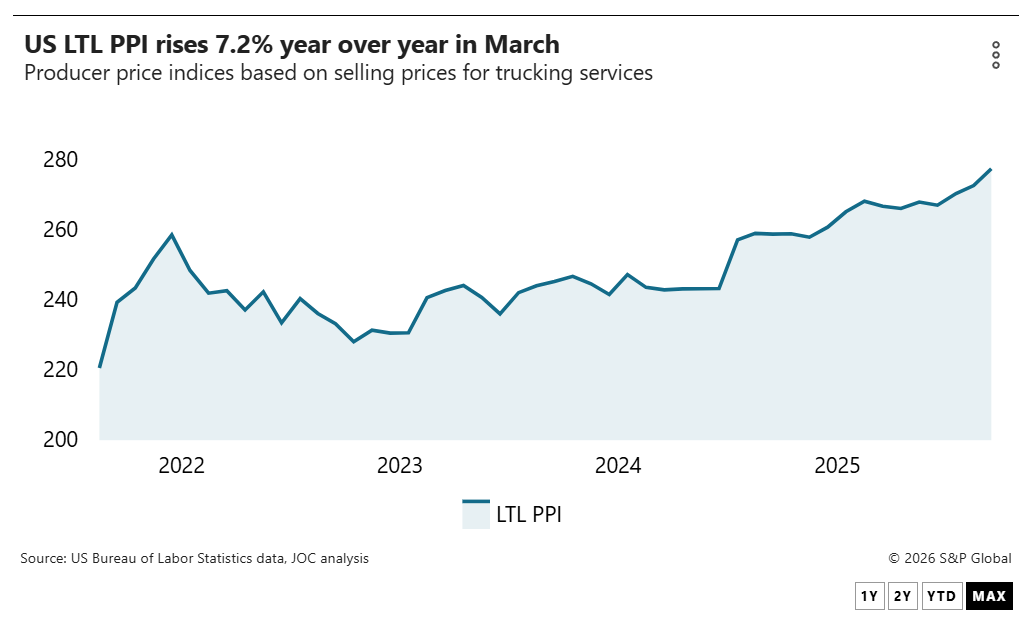
The LTL PPI rose 1.8% in March from February after climbing 0.8% month over month in February and 1.3% in January. On an annualized basis, the PPI rose 7.2% in March, compared with 5.3% and 5.2% year-over-year gains in February and January, respectively.
The PPI is a measure of all-inclusive “selling prices,” and fuel surcharges certainly contributed to March’s gain. But LTL costs and rates have remained elevated since 2022, with carrier yield management balancing reduced volumes, according to AFS Logistics.
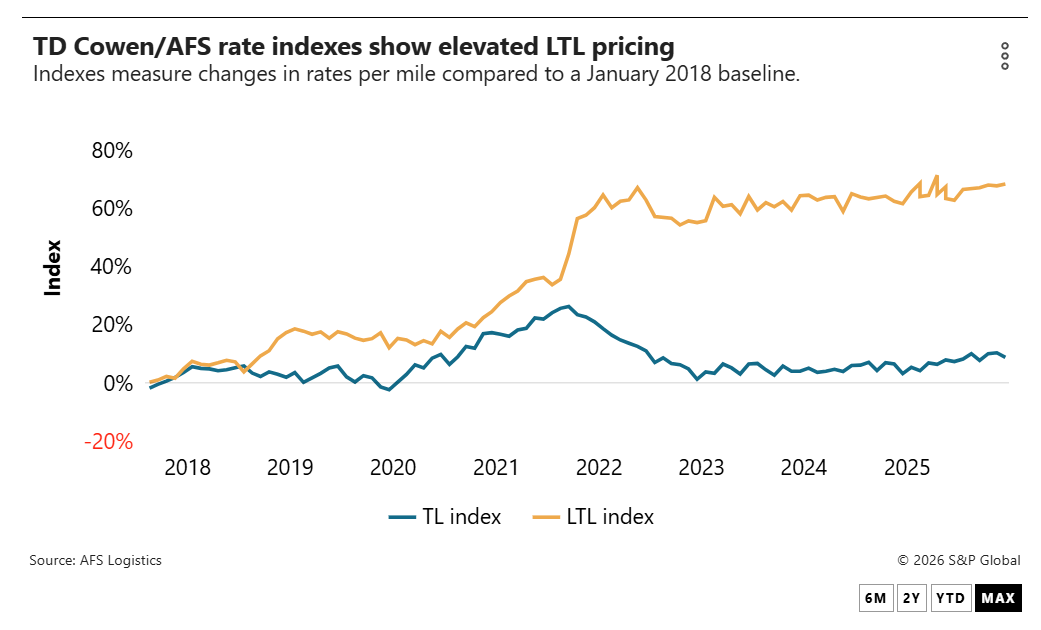
Although the TD Cowen/AFS LTL Freight Index dropped slightly from the fourth quarter to the first quarter, the index rose year over year and is expected to climb to a new four-year high of 68.4% in the second quarter.
“The LTL carriers are in a very unique position — their buckets are being filled from both ends,” said Andy Dyer, CEO of AFS, a third-party freight management company.
Those “ends” are the truckload and parcel markets, both of which have seen substantial rate hikes, Dyer said. That’s pushing more freight to the LTL sector. Shippers are “managing the freight, not just paying the freight,” he said.
That means they’re more willing to deconsolidate truckload shipments and consolidate parcel moves, and LTL rates that looked high last year now seem more reasonable.
Persistent uncertainty
It’s not clear if the increase in LTL demand will be long-lasting or short-term, or whether it signals a stronger industrial revival or tariff-related inventory reshuffling.
For now, the LTL outlook — for providers — is brighter. At regional carrier Pitt Ohio, “bill count is picking up and now revenue is, too,” said Geoff Muessig, the company’s chief marketing officer.
In the Northeast, the year got off to an “uneven start,” as successive winter storms swept the region, he said. In February, the Pittsburgh-based carrier saw better results, and demand got stronger in March through the start of the second quarter, Muessig said.
“April’s bill count is solid,” he said. “Our same-store sales [shipments with existing customers] are rising. It’s a pleasant place to be.”
The change is not a return to the heady years of 2021 through 2023, when post-COVID-19 demand and disruption from the failure of LTL provider Yellow sent pricing up by double-digit percentages. But it’s a respite from the freight doldrums of 2023 to 2025.
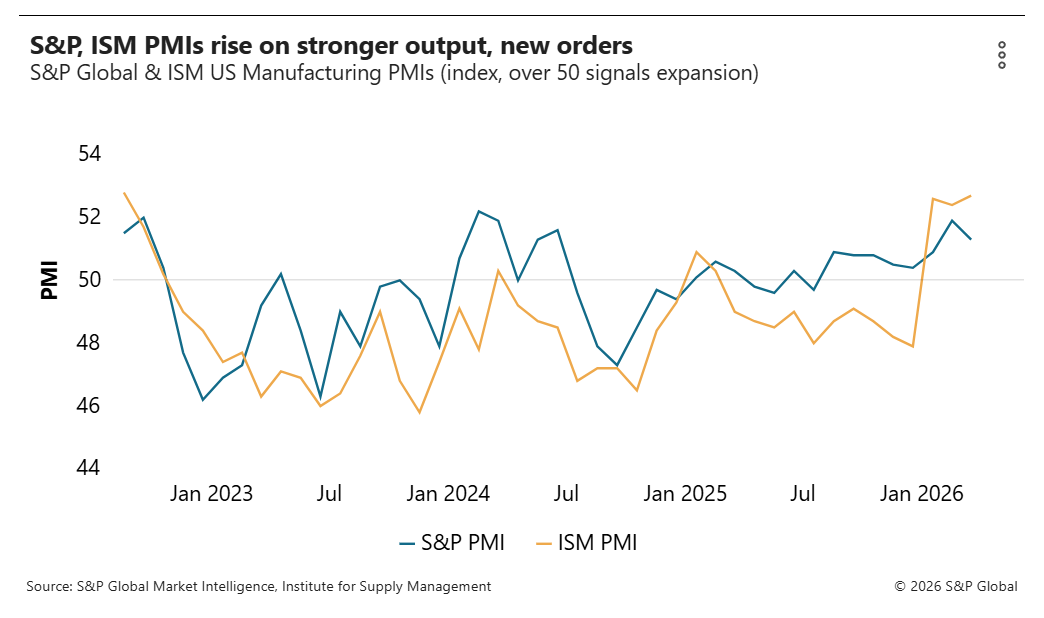
An industrial uptick benefiting Pitt Ohio shows in Manufacturing Purchasing Managers’ Indexes (PMIs) from the Institute of Supply Management (ISM) and S&P Global.
The ISM PMI rose 0.3 percentage point to 52.7% in March, the third month for the PMI above the 50% no-change mark. ISM’s new order index remained positive but dropped from 55.8% in February to 53.5% last month. ISM’s production index was 55.1%.
The S&P Global US Manufacturing PMI has been above 50% since last August, and higher output and new orders pushed it up 0.7 percentage point to 52.3% in March.
That gradual industrial expansion is putting more freight in LTL trailers. XPO and Saia, the US’ fourth- and sixth-largest LTL providers, respectively, both reported an annualized gain in daily shipments in February. Full first-quarter data will be available later this month.
Daily shipment counts at FedEx Freight, the largest US LTL provider in terms of revenue, have fallen 14% since 2023 and dropped 5.7% year over year in the quarter that ended Feb. 28. But the company expects volume to grow again in the midterm.
“There are absolutely GDP [gross domestic product] and PMI correlations, and as the market goes, we’ll feel that impact,” CFO Marshall W. Witt said during an April 8 investor day presentation to Wall Street analysts.
Carriers are vying more for profit than revenue or pure market share.
“Profitable growth is now our North Star,” Witt said. “It aligns our decision-making in our organization around profitability rather than just revenue in isolation.”
But they’re also looking for new sources of freight, beyond traditional industrial LTL shippers. LTL providers such as FedEx Freight are adjusting their freight mix, said AFS’ Dyer. “We’re seeing some mix changes in the stuff we’re handing to the LTLs,” he said.
‘Not time to add capacity’
How long current volume trends will continue is an open question.
The LTL market has improved, “but it’s a combination of truckload capacity coming out plus the fuel prices,” said Satish Jindel, president of SJ Consulting Group.
“LTL carriers should be looking at this as a perfect time to ask how they can use the various forms of technology available right now, including AI [artificial intelligence], to handle more freight with the same physical network,” Jindel said. “It’s not a time to add capacity.”
There are signs that higher LTL volume comes from inventory rebalancing, not new demand, said Keith Prather, managing director of Armada Corporate Intelligence.
The US-Israel conflict with Iran may squeeze already lean inventories, putting pressure on supply chains and inbound freight, both globally and domestically, Prather said.
“I’m not calling for a global supply chain crisis, but I do think stock-outs and some scrambling will take place over the next few quarters,” he said.
The closure of the Strait of Hormuz “killed everything way upstream,” Prather said. “All of a sudden, you get inventories that are too lean.” That could spur demand but also crimp production and shipments.
“Q2 has the potential to be robust, but do we pay for it in Q3?” he said.