

The tightening of truckload capacity and a sharp rise in diesel prices are beginning to reset surface transportation rates in the US, giving carriers renewed leverage while opening a potential growth opportunity for intermodal rail.
Crackdowns on non-domiciled commercial drivers and stricter English-language enforcement are constraining truckload capacity after a four-year freight recession. Meanwhile, diesel prices have surged to their highest level since late 2022 amid the war with Iran, lifting transportation costs for all and forcing shippers to reassess their budgets.
It has started a cascading effect across domestic US transportation.
Brokers and asset-based truckload carriers are rejecting freight and insisting on renegotiating contract rates, while shippers facing blown transportation budgets consider cheaper options such as intermodal rail.
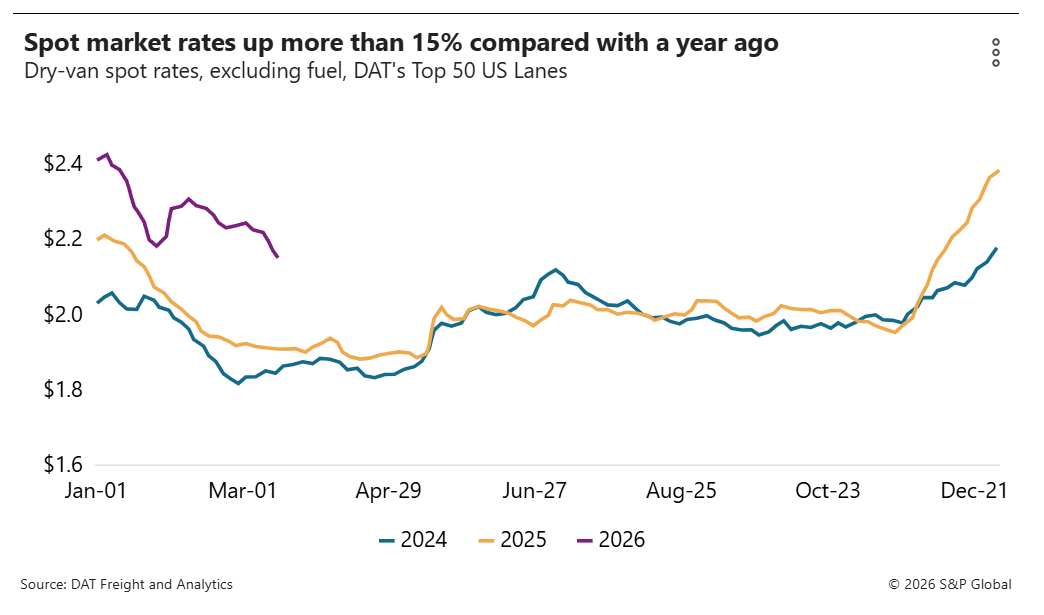
Early signs of that repricing are already evident.
Spot truckload rates are up between 15% and 20% from a year ago, according to DAT Freight & Analytics, even as freight demand remains muted amid elevated interest rates, a lackluster housing market, and mixed signals from the US industrial sector.
“Not only are you seeing elevated rates across other modalities such as flatbed, but in the overall dry-van market, you're seeing 14%, 15% tender rejections coming out of the slowest freight month of the year,” said Jared Weisfeld, chief strategy officer for RXO, a non-asset broker, speaking at the J.P. Morgan Industrials Conference on Tuesday.
As recently as last year, tender rejections were at or less than 5%, according to Weisfeld.
Regulatory tightening reinforces supply constraint
The supply side could tighten further as new federal regulations take hold. The Federal Motor Carrier Safety Administration (FCMSA) enacted a rule earlier this week restricting non-domiciled commercial driver’s licenses (CDLs), a move the agency estimates could remove up to 194,000 drivers over five years.
On Wednesday, the US House of Representatives advanced “Delilah’s Law,” which would accelerate enforcement over non-domiciled CDLs by retroactively invalidating certain licenses, rather than waiting for a non-domiciled CDL holder to interact with state licensing agencies.
Despite higher rates, fleets have been cautious about adding capacity, even though stricter emissions regulations in 2027 will increase the purchase price of a new truck.
“Our customers are more middle- to smaller-sized [carriers], and I think there’s still a lot of hesitation on that side to make the decisions,” said Cristina Gallo-Aquino, CFO of Ryder Systems, speaking at the J.P. Morgan event. “We are pointing it all out to them to show them how much of a price increase could be coming ... but we haven’t really seen the shift to make a decision and preorder.”
Fuel surge amplifies pricing pressure
Diesel prices averaged $5.07 per gallon last week, according to the US Energy Information Administration, the highest since November 2022 and adding another layer of cost pressure across the truckload market.
On the spot market, where rates are often negotiated on an all-in basis, the increase is squeezing owner-operators and smaller carriers that cannot pass through fuel costs. That dynamic may cause more capacity to exit the truckload sector.
In the contract market, larger asset-based carriers pass through higher fuel costs via surcharges. Since March 1, the average surcharge has risen nearly 20 cents per mile, although methodologies vary. For shippers, the result is sticker shock on invoices and a renewed focus on lower-cost alternatives such as rail.
“For the intermodal space, it starts to put pressure on truck rates, which is a pretty good thing for us,” Mark George, CEO of Norfolk Southern, said at the J.P. Morgan event. “We’ve been pretty depressed [price-wise] for a while. We’d love to see some evacuation of capacity in trucking.”
Intermodal providers are already prepared for that shift.
Darren Field, president of intermodal at J.B. Hunt Transport Services, said the company is actively engaging with shippers looking to manage rising transportation costs.
“How can we convert business from the highway back to intermodal, or to intermodal for the first time to hopefully save you a little money and prepare your budget for a year where truckload capacity and prices could get difficult for you,” Field said at the J.P. Morgan conference. “How can you hedge against the potential for a cost increase coming at your budget as a shipper by utilizing more intermodal?”
But capturing that opportunity will depend on execution. Railroads must maintain service reliability even as volumes rise, a lesson of the pandemic when congestion and labor shortages left intermodal with a lingering stigma among some shippers.
Service metrics suggest the industry has made progress. In a Journal of Commerce survey conducted late last year, 91.3% of respondents said they were satisfied with domestic intermodal service, up from 45.3% in the spring of 2023.
Whether that improvement holds under renewed demand may determine how much freight ultimately shifts modes.
Shippers, having experienced pandemic-era disruptions, are unlikely to tolerate a repeat.