

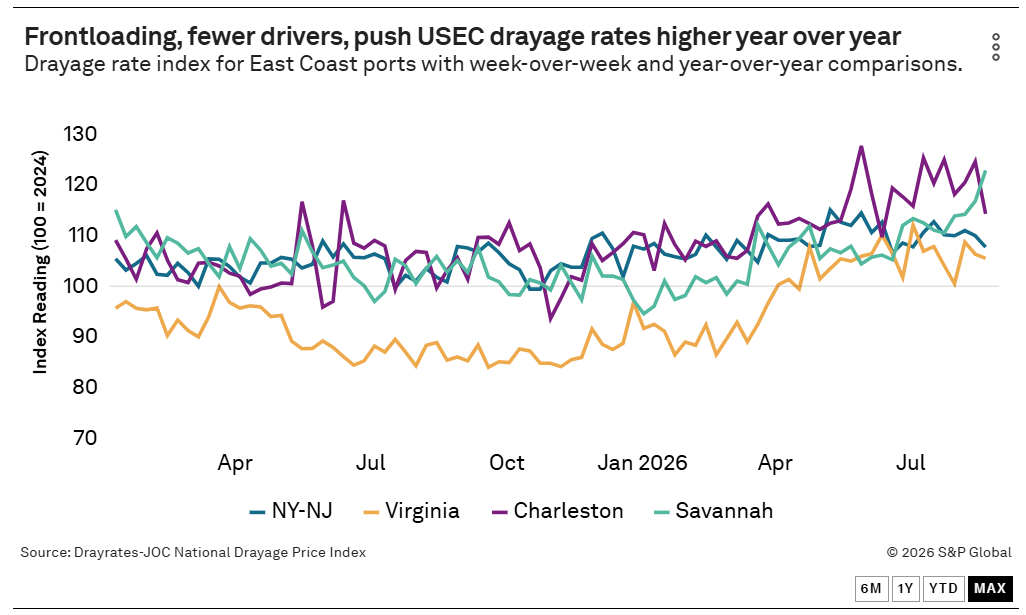
Shippers face double-digit increases in spot drayage rates, particularly at East and Gulf coast ports, due in part to higher fuel prices and tighter equipment and driver availability. Some shippers are also tapping fewer drayage carriers than they have previously due to risk concerns following the verdict in the US Supreme Court truck broker liability case.
Spot intermodal truck rates from major East and Gulf coast ports as of mid-August were up 12% and 17%, respectively, from a year ago, according to the Drayrates-JOC National Drayage Price Index. Mid-Atlantic and Southeast ports have seen larger gains, with drayage rates out of Norfolk up 23% and Savannah seeing a 19% rise year over year, according to the index.
Norfolk and Savannah reported year-over-year increases in import volumes between May and July. The Georgia Port Authority said it saw between 1,000 and 1,500 more daily truck transactions in late July compared with June.
Houston saw year-over-year import gains in May and June, with a small dip in July.
Most of the drayage rate gains have come since the current round of import frontloading began in late spring, Michael Kroul, chief executive of Minnesota-based broker KTI, told the Journal of Commerce. Across the port and inland markets KTI serves, Kroul said spot intermodal rates have risen 15% to 20% since the start of summer, while shippers are also covering higher diesel costs. Data from the Energy Information Administration shows average diesel prices in the US have risen 45% since March.
Chassis availability at some port and inland markets has also become an issue for shippers due to longer street dwells for import containers and out-of-service chassis. Shippers are looking for motor carriers that have their own equipment to avoid delays, Kroul said.
“We are not in a race to the bottom for pricing right now,” he said. “Fuel is pushing this total cost up.
“The market became accustomed to easy access to chassis, but this supply has tightened, forcing many shippers to rely on brokers or carriers with access to private chassis,” Kroul added.
Ben Banks, president of Georgia-based motor carrier TCW, told the Journal of Commerce a tighter overall trucking market is also hitting drayage. He has had to increase driver wages 5% through August, the first such raise in three years, with more raises likely later this year. The Intermodal Association of North America (IANA) said there are 15,000 fewer drivers than there were in December 2025.
“The market is tightening, but it’s not at crisis stage,” Banks said. “Trucks are rolling five days a week.”
Fuel prices have also played a role in which containers truckers are accepting because “container lines do not regularly update their fuel surcharges” for truckers, Banks said. He is only familiar with one ocean carrier that has started accepting weekly fuel surcharges since March.
Safety concerns on the rise
Jason Hilsenbeck, president of online carrier platform Drayage.com, told the Journal of Commerce that searches across Southeast and Gulf Coast markets for port trucking have been on the rise since June from ocean carriers, forwarders and cargo owners.
Shippers seem to be more selective about their carriers now, Hilsenbeck said, which is also fueling the search for capacity. This stems from the US Supreme Court’s May decision that found brokers could be held liable for accidents involving the truckers to whom they tender freight.
Hilsenbeck said the ruling’s citing of “ordinary care” for selecting a motor carrier is now extending to other shippers who may contract directly for drayage without a broker. He said at least two shippers have told him they are searching for new truckers to replace an agent-based drayage carrier that leases trucks because the carrier no longer meets their new safety thresholds.
A report on the carrier’s Federal Motor Carrier Safety Administration’s (FMCSA’s) seven safety scores viewed by the Journal of Commerce showed that in May, the carrier’s unsafe driving score was higher than the threshold set by other peer carriers. The unsafe driving score has remained above the threshold through July. The Journal of Commerce is not identifying the carrier due to its relationships with other customers.
Unsafe driving became the carrier’s third negative score recorded by the FMCSA, adding to other above-threshold scores for hours-of-service violations and vehicle maintenance. Most of the carrier’s inspections occurred in Georgia, and the carrier appears to have done much of its recent business with Savannah port customers.
It takes a minimum of two negative safety scores to trigger more thorough FMCSA safety inspections, said Michael Edwards, senior vice president of carrier insurance broker Gallager. At minimum, shippers could see on-the-road delays due to the inspections.
Still, the carrier has had an overall satisfactory safety rating since 2009, which Edwards said is the highest rating possible. Caribe Transport, the carrier defendant in the Supreme Court’s Montgomery decision, only had a conditional rating, so “they’re hardly the same carrier,” he added.
Edwards said it’s reasonable that some shippers are more risk-averse following the Montgomery decision. Even so, having three negative scores itself is not necessarily a reason for shippers to entirely abandon the carrier, he added. Various estimates point to at least 90% of motor carriers not having any kind of safety audit from the FMCSA, along with a like percentage of trucks not being inspected each week.
The FMCSA safety scoring system has flaws, Edwards said, including its reliance on peer carriers. Truck counts, a factor which sets the peer groups, can be inaccurate as other carriers lease trucks on and off to game the scoring system or inflate capacity for shippers, he said.
“The peer groups are based on a self-reported number of vehicles and mileage,” Edwards said. “There’s a lot of that going on in the business and FMCSA doesn’t seem to have an answer for it.
“The shippers do need to move freight, and there are only so many trucking companies with two or less alerts, so exceptions will be made,” he added. Carriers with three negative scores “just need to formulate some type of corrective action plan on how they plan on dealing with the alerts,” Edwards said.
KTI’s Kroul said prior to the Montgomery decision, 80% of shippers had no interest in reviewing safety scores. While he would be “hesitant” to broker a shipment to a carrier with three negative scores, Kroul said that alone is not enough reason to entirely cut off a carrier because of the flaws in the scoring system.
“That is a risk management decision,” Kroul said. “We’ve had all these drivers come into the ocean market over the last three, four years and it’s been loose and easy. Now, shippers just don’t want to use anybody anymore.”