

Large and midsize retailers in the US face the possibility of having their newly agreed service contract rates more than double this summer due to increased bunker fuel costs and hefty peak season surcharges (PSSs) that are being added to base rates.
Most retailers secured rates of about $1,700 to $1,900 per FEU from Asia to the West Coast and $1,000 per FEU higher to the East Coast in the 2026–27 service contracts, most of which took effect on May 1. Those rates were slightly lower than what retailers paid in their 2025–26 contracts.
However, the bunker adjustment factor (BAF) for contracts that reset quarterly is due to increase by about $300 to $400 per FEU on July 1, reflecting the surge in global oil prices linked to the war in the Middle East, forwarders told the Journal of Commerce. Other retailers whose contracts stipulate a monthly reset are already paying the higher BAFs.
Also, most carriers, emboldened by the exceptionally strong demand in the eastbound trans-Pacific in May, are hitting retailers with PSSs of $2,000 per FEU, forwarders said. Retailers have been frontloading fall and holiday merchandise ahead of new tariffs and what could be even higher fuel prices.
“They (retailers) will definitely see higher BAF rates,” one forwarder said. “Carriers are going to try to get a $2,000 PSS, which will take the contract rates to $4,000.”
May imports exceptionally strong
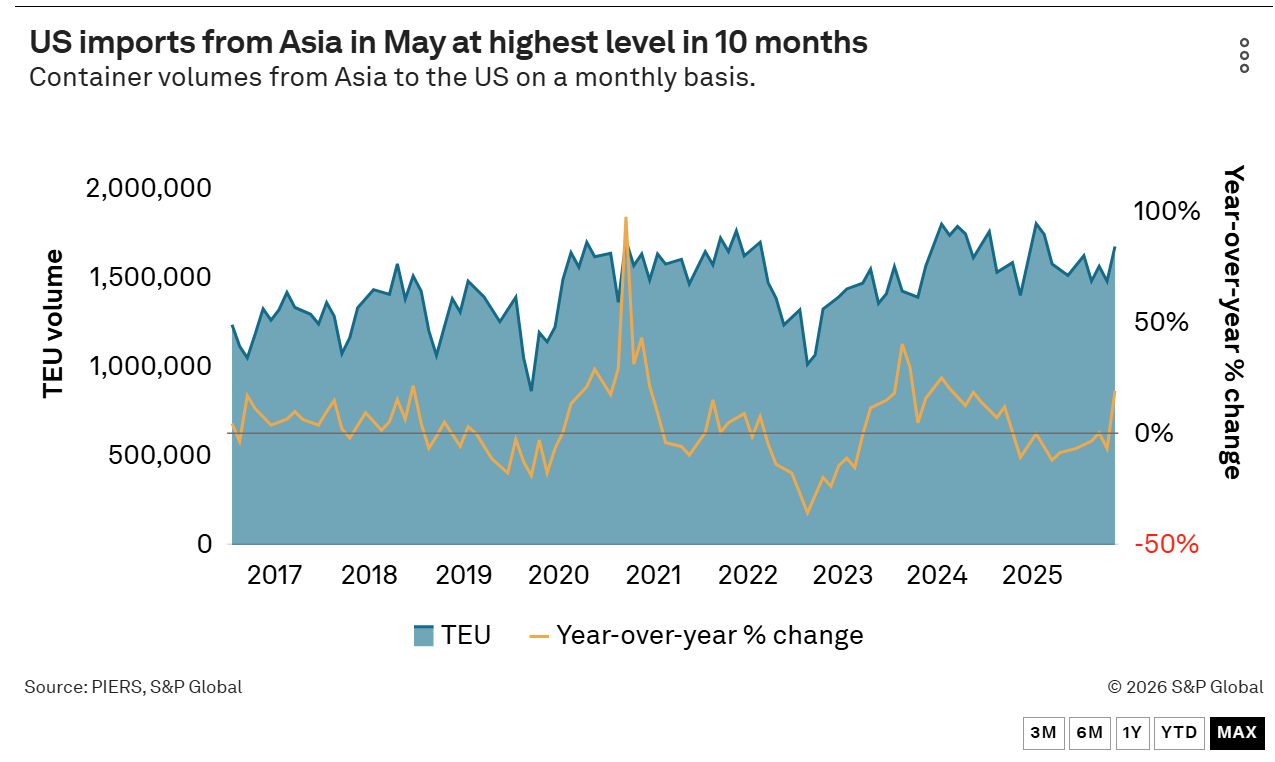
US imports from Asia in May jumped to 1.68 million TEUs, up 13% from April, almost 20% higher year over year, and the highest since last August, according to PIERS, a sister company of the Journal of Commerce within S&P Global.
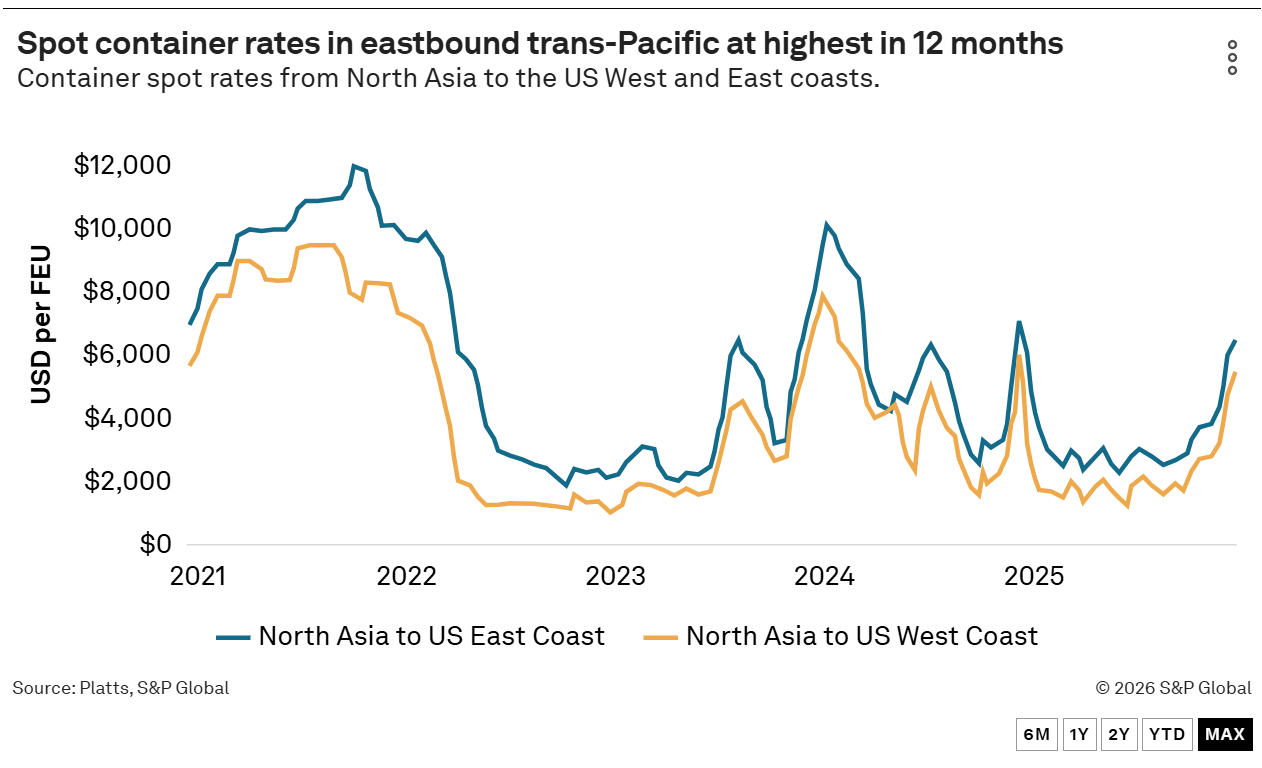
Spot rates in the eastbound trans-Pacific have been increasing steadily since mid-April. As of Monday, rates to the West Coast were $5,500 per FEU, up 10% on the week, according to Platts, a sister company of the Journal of Commerce. East Coast rates of $6,500 per FEU were 7% higher week over week.
Retailers and other direct importers pay spot rates on noncontract shipments.
Carriers, meanwhile, have been implementing general rate increases (GRIs) on a twice-monthly basis this spring. Forwarders say carriers have filed with the US Federal Maritime Commission for another GRI on July 1, and they expect at least some portion of the charge will stick.
Import volumes this spring have been higher than many economic forecasters had predicted, given macroeconomic factors such as US GDP growth that came in below expectations in the first quarter, said Michael Britton, head of North America ocean products at Maersk. However, customer forecasts indicated there was strength in the trans-Pacific market.
“We do a lot of work with a lot of different customers. And when we look at some of their forecasts, they were already indicating May and June were going to be higher than April,” Britton told the Journal of Commerce.
Since demand is likely to remain strong at least into July, customers could expect at least one more GRI on July 1 and another PSS next month as well, said Christian Sur, executive director of global sales at the forwarder Glovis America.
“Carriers are certainly trying to take advantage of the situation,” Sur said. “Timing is everything.”
Forecasting demand and freight rates into August, September and October, the traditional peak season in the eastbound trans-Pacific, is more difficult. Britton said 30-day forecasts by carriers and their customers have generally proven to be reliable.
“(But) as you go to 60, 90 (days), it starts losing some consistency, let’s say,” he said.
A second carrier executive expects the frontloading of fall and holiday merchandise to continue in July and maybe through August. “The frontloading is real,” the source said.
The National Retail Federation (NRF) has upgraded its forecast for June imports, confirming that the peak shipping season has come early this year. But the NRF says that spike is expected to be short-lived, with the group lowering its prior forecast for imports landing through the rest of the summer and into early fall.
An index produced by maritime intelligence provider Vizion showed booking demand for Chinese imports increasing. The index hit its 2026 high of 117 for the week ended May 11, the most recent data available.
No repeat of last summer
Last summer, US imports from Asia climbed rapidly in June, peaked in July and then fell just as quickly as they rose. Comparing the current environment to last summer does not provide guidance as to what to expect this year, said Jason Cook, CEO of Ardent Global Logistics.
The fundamental difference is that growth last summer was confined to the US, so carriers were able to redeploy vessels from other trade lanes to the trans-Pacific. That’s why the price spike lasted only two months. This year, demand is also strong and rates are moving higher in the Asia-Europe, Asia-Mediterranean and South American trades, and that is limiting the capacity and equipment that can be deployed into the trans-Pacific, Cook said.
“This time around, it’s different. There are no ships that are all of a sudden going to quickly move to the trans-Pacific,” he said. “That might mean you’re going to get (rates) higher for longer.”