

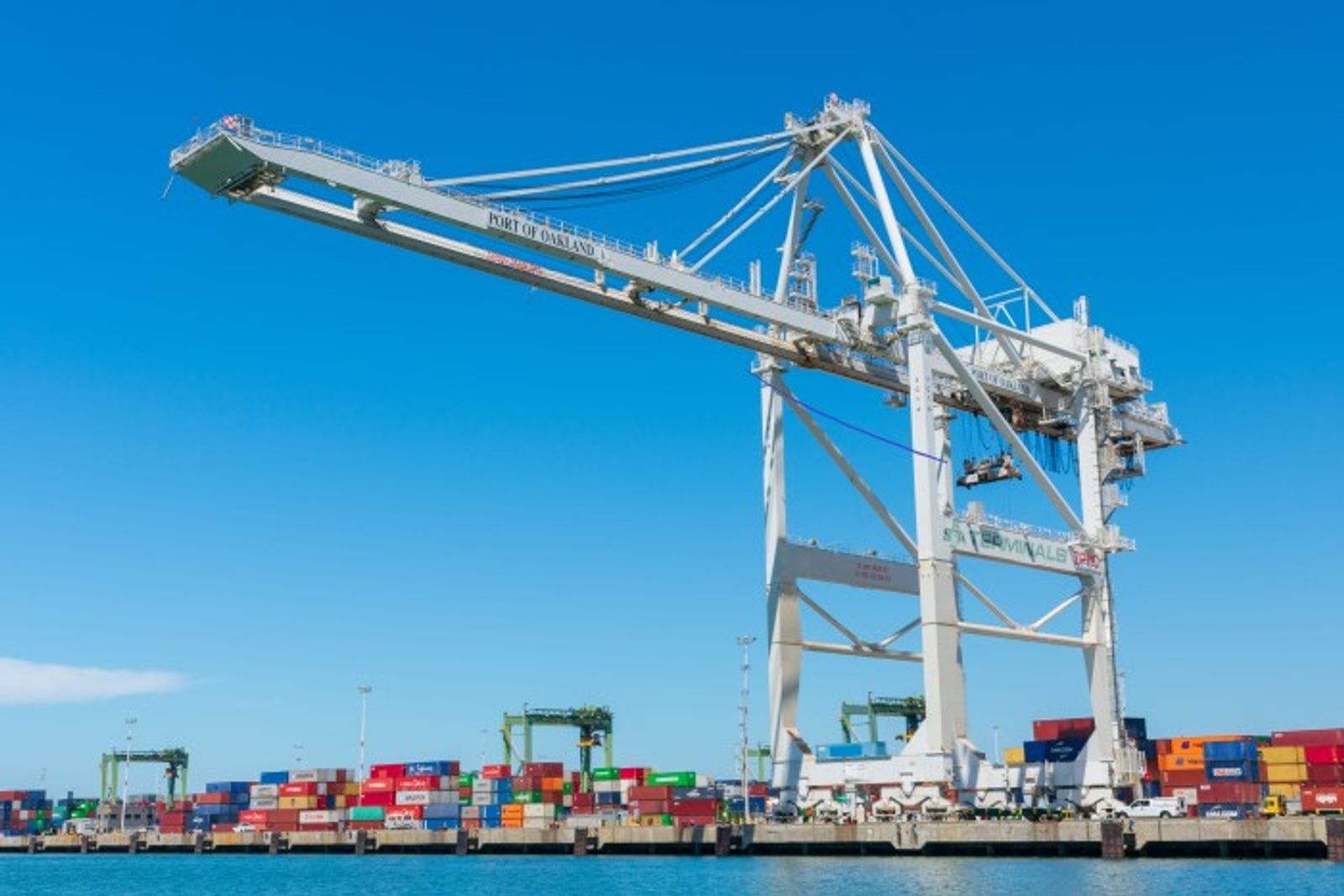
US ports face an almost $7 billion price tag for ship-to-shore cranes and other container-handling equipment over the next five years, according to the National Association of Waterfront Employers (NAWE). But the spending is hamstrung amid an unclear tariff on Chinese cranes and halting efforts to reshore crane manufacturing to the US.
In a survey of 25 port and terminal executives published Tuesday, NAWE said US ports and marine terminals will need more than 100 ship-to-shore (STS) cranes through 2031 to replace aging assets or provide new crane capacity. In total, NAWE expects US ports to need $6.7 billion in equipment over the next five years.
“These findings underscore the scale and urgency of the investment challenge facing US ports,” NAWE President Carl Bentzel said in a statement accompanying the survey. “Modern cargo-handling equipment is essential to ensuring terminal productivity, supply chain resilience, and the ability of US ports to compete with international gateways.”
New and replacement cranes, along with other cargo-handling equipment, account for $5.1 billion of NAWE’s estimate. In addition, US ports are looking to spend $917 million on rail-mounted stacking cranes and another $790 million for repairing existing STS cranes and equipment.
Along with the equipment bill, Bentzel told the Journal of Commerce that equipment is just the “tip of the iceberg” as US ports need to spend many billions more to improve underlying infrastructure including road, rail and maritime access.
NAWE released the survey as Congress takes up other infrastructure-related legislation, including the five-year surface transportation reauthorization, which provides federal support for roads and bridges.
Bentzel said NAWE is looking to get the attention of both Congress and the White House about how they can help expedite and support those equipment purchases. NAWE members face uncertainty from Washington’s dual mandates of penalizing China’s maritime industry and how to reshore critical industries such as crane manufacturing.
US ports faced an array of Trump’s tariffs that added 30% to the cost of Chinese-made cranes. In addition, the United States Trade Representative (USTR) levied a 25% penalty on Chinese-made ship-to-shore cranes under a 2024 investigation begun during the Biden administration.
Under the Trump administration, the USTR intended to stack another 100% penalty on Chinese STS cranes as of last November. The Supreme Court has knocked down almost all of Trump’s reciprocal tariffs against China, while the USTR put a one-year pause on its 100% penalty.
Even so, Bentzel said it is unclear what the current tariff regime is for Chinese-made cranes, or if the Trump administration is even enforcing the Biden-era tariffs on cranes. NAWE called on the USTR to clarify the current state of penalties and tariffs on Chinese cranes.
“The challenge is we don’t know what is happening with the United States Trade Representative,” Bentzel said. “There’s going to be a short-term need to continue using Chinese manufacturers. But no one in the industry can arrange for the construction and delivery of cranes with a one-year suspension.”
An executive for a North American terminal operator who took part in the survey told the Journal of Commerce his STS crane purchases are running about $25 million currently, compared to roughly $15 million a year ago. Global prices have risen due to the tariff and the switch to crane makers, enabling the manufacturers to raise prices due to new demand and limited capacity, he said.
“Our main reason for reaching out to the USTR is because we want to make sure that we have certainty about the exact import duties at the time when we place an equipment order,” the terminal executive said. “Nobody can afford to order equipment and then suddenly get a 10% cost increase from new import duties after this equipment order has been contracted.”
Crane makers eye US yards
In the long-term, Bentzel said critical industries such as crane and yard equipment need to be reshored so US ports will not be reliant on Chinese manufacturers. He said the White House and Congress need to begin the process now for reshoring crane manufacturing as it will take two years or more for a domestic manufacturer to start making cranes.
NAWE recently added new members including European crane manufacturers Liebherr and Konecranes, along with Japan’s Paceco-Mitsui, as part of its outreach to reshore crane manufacturing, Bentzel said. Germany’s Kunz and Phoenix-based Stafford Port Cranes are also looking to join NAWE, he added.
Sources have told the Journal of Commerce that Liebherr has inquired about laydown yard space at the Port of Houston, along with other Gulf and Southeast ports, for assembling and distributing cranes. has sought similar space at the Port of Seattle, according to sources.
Liebherr and could not be reached for comment.
Bentzel said the companies are only making soft inquiries now as they await clarity about long-term US trade policy on STS cranes. The Biden administration made $20 billion in infrastructure funding available for STS crane makers to set up US operations. At the time, Paceco said it would invest in a new US facility, but it never went forward due to market uncertainty, Bentzel said.
“NAWE’s members are supporting the onshoring of port cranes,” he said. “Those companies are doing a lot of assessing and waiting because the penalties on Chinese-made cranes aren’t clear.”
With the Trump administration looking to revive the US maritime industry, Bentzel said now is the time to support US-made cranes. NAWE’s capital spending survey also sets the table for these companies on their addressable US market, he added.
NAWE plans to lobby Congress to have funding made available to domestic crane manufacturers under the Defense Production Act, which supports industries critical to national security, or the Shipbuilding and Harbor Infrastructure for Prosperity and Security for America (SHIPS) Act, Congress’ broad bill to incentivize the reshoring of ship building and crane-making.
“Our argument is that if we don’t have this equipment and don’t create this domestic market, this will impact the nation’s fortunes in the long-term,” Bentzel said. “We believe without some level of assistance and direction, it will take us two years to get any domestic production going.”
One potential incentive that has been floated is the 2021 Build America, Buy America (BABA) Act, which requires infrastructure to be built with a minimum of 55% US-sourced steel to receive federal funding. However, the terminal executive said not enough of the actual crane parts can be made in the US at this point to qualify.
“Crane assembly in the US not enough to be BABA compliant,” he said. “This will require on top of the assembly to also get some of the components sourced from the US."