

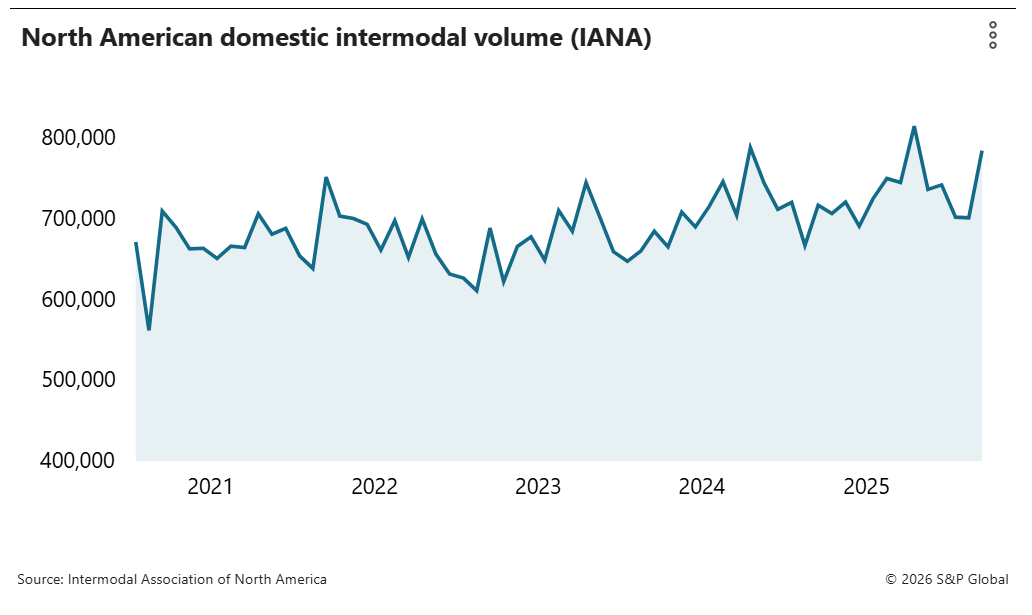
North American railroads hauled more than 785,000 domestic containers in March, the third-highest monthly total on record and the strongest March ever, new data shows, as shippers shifted more freight from truckload to intermodal to offset rising highway transportation costs.
The jump in domestic intermodal volumes shows how quickly freight can move to rail when truckload pricing increases. But the sustainability of that shift will depend on whether railroads can shed the stigma of service meltdowns that occurred five years ago during the pandemic-related freight surge.
The Intermodal Association of North America (IANA) reported March domestic volumes grew 9.5% year over year. That came as intermodal providers Knight-Swift Transportation and J.B. Hunt Transport Services reported more than 8% growth last month.
IANA also reported that first-quarter domestic intermodal volumes rose 4% over the first quarter of 2025.
“We are more optimistic today than we were in January in terms of truck conversion opportunities — primarily in our domestic intermodal business,” Maryclare Kenney, CSX Transportation’s executive vice president of sales, said on the railroad’s earnings call Wednesday.
Union Pacific Railroad (UP) reported a first-quarter company record for domestic intermodal, while CSX said total intermodal volume, including international business, rose 6% year over year during the same period. Neither railroad breaks out intermodal volume by container size, but IANA said domestic intermodal traffic in the eastern US jumped nearly 10% year over year in Q1.
Rail visibility provider RailState said UP’s domestic intermodal volume in Southern California climbed more than 20% year over year in the first quarter.
CSX, J.B. Hunt, Knight-Swift and Union Pacific all expect domestic intermodal volumes to remain strong in the second quarter as truckload rates rise. The Journal of Commerce forecasts that domestic intermodal volumes will increase 3% to 4.5% year over year in the second quarter, based on an analysis of historical trends.
The robust volume outlook comes as Knight-Swift said contract truckload rates could rise by as much as low-double-digit percentages this year, increasing the likelihood of further conversion to intermodal, if railroads can maintain reliable service.
Trucking rates have climbed sharply since December due to a combination of severe winter weather, regulatory crackdowns that have canceled the licenses of certain immigrant truck drivers, enhanced enforcement of English language proficiency of all drivers, and surging fuel costs because of the war with Iran.
Intermodal pricing will follow trucking, eventually
Intermodal pricing has yet to respond as sharply as truckload rates, reflecting the usual lag between changes in highway and rail pricing. The Journal of Commerce Intermodal Savings Index shows only modest growth in intermodal contract rates through March 31, not enough to match broader inflation in the US.
“We are getting some improvement in rate — not near what you are getting on the truckload side — but some improvement,” Knight-Swift CEO Adam Miller said during an earnings call Wednesday. “We expect intermodal to be profitable and to see that improve as the cycle strengthens.”
UP said raising intermodal rates depends first on service; railroads can charge shippers more if they deliver a product that provides clear advantages for shippers.
“We sell to Denver, we sell Salt Lake City, we sell Santa Teresa [El Paso] and into Mexico,” UP CEO Jim Vena said in an interview with the Journal of Commerce on Thursday. “Price is not always the number that is most important for customers. Many look at it as a full supply chain solution.”
Vena said maintaining service also includes constant communication with partners including Hub Group, Knight-Swift, Schneider National, STG Logistics, and other intermodal marketing companies and intermodal shippers.
“Our operations department doesn’t make a change without having sales understanding the impact, and sales doesn’t talk about changing freight flows without operations tied into the process,” Vena said. “That’s how we communicate with our customers.”
More growth comes with Howard Street Tunnel
CSX also revealed that double-stack intermodal trains will begin moving through the Howard Street Tunnel in Baltimore as soon as next week, expanding service options on a key East Coast corridor. The railroad expects the change to cut a full day off transit times to New Jersey for freight originating in Chicago and for traffic handed off from BNSF Railway in the western US.
The savings would come by routing Midwest cargo through Baltimore instead of sending trains through Buffalo and central New York before turning south to New Jersey.
CSX’s Kenney said some intermodal growth could come quickly, particularly along the Interstate 95 corridor, but other freight will take longer to win because annual contracts, rather than operational readiness alone, determine cargo flows.
“We have been talking to our channel partners and shippers for a while about [Howard Street]; they are very excited about it,” Kenney said. “We are coming to the tail end of this year’s bid season, but we are seeing some traction, and that will continue to build over the course of the next year or so.”
Similar to UP, the test for CSX is whether it can maintain reliable service as volumes rise. The railroad has already absorbed a 15% increase in container lifts at its terminal in Fairburn, Georgia, outside Atlanta.
Multiple intermodal marketing companies told the Journal of Commerce that truck turn times for retrieving containers at the terminal have ballooned since April 1 amid the higher volumes.
“We are focused on continuous improvement and continue to invest in our intermodal facilities to ensure we have the capacity to support customer demand while maintaining service our customers can count on,” CSX said in a statement to the Journal of Commerce.